
North Stanmore delivers globally exceptional 72% Heavy Rare Earth ratio and a second zircon Hafnium product
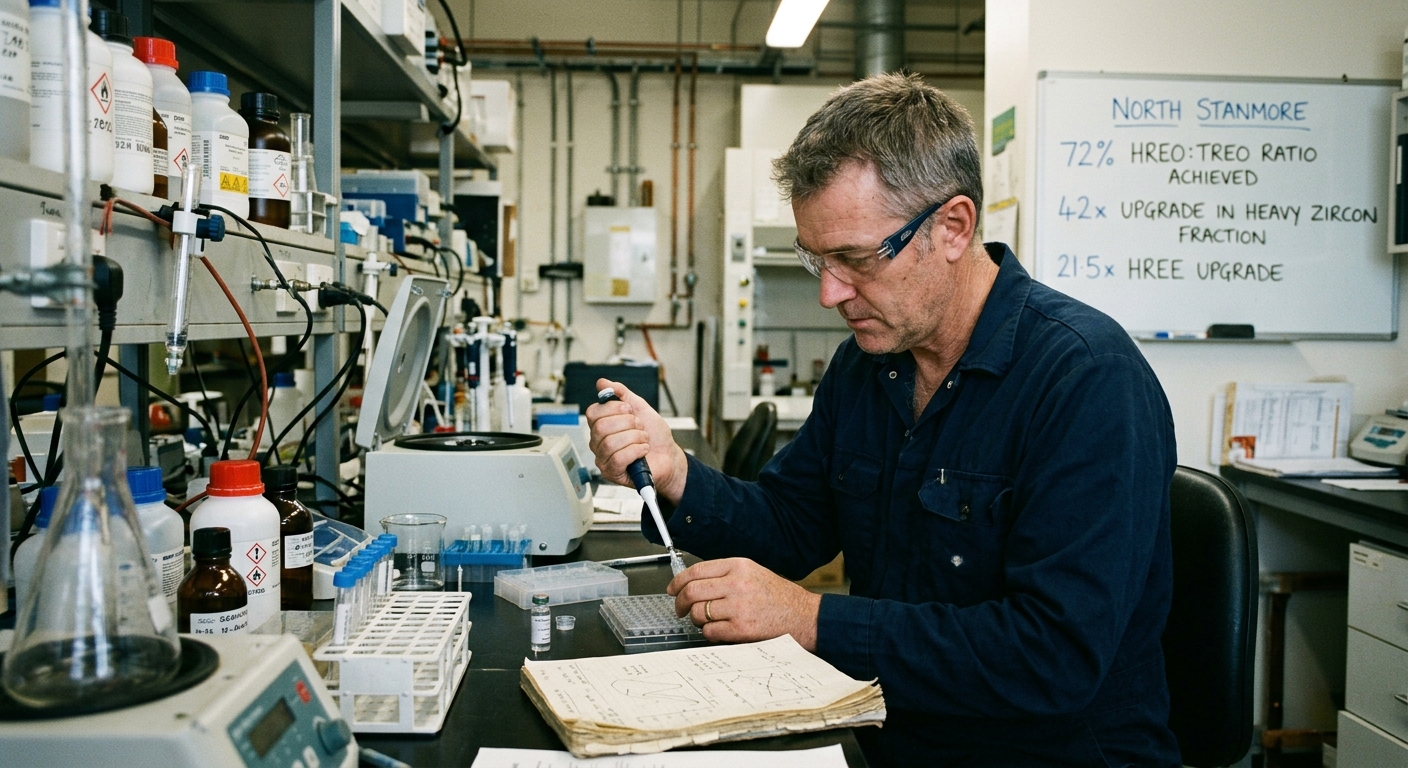
- 72% HREO:TREO ratio achieved in a clean pre-concentrate - 42x upgrade in the heavy zircon fraction - 21.5x Heavy Rare Earth (HREE) upgrade
Victory Metals Limited (ASX:VTM) byàã¬N8uzor the y!5•uzc is pleased to announce a landmark separation achievement at its 100% owned North Stanmore Heavy Rare Earth (HREO) Project in Western Australia.
Metallurgical and mineralogical test work has confirmed recovery of relict primary zircon crystals from coarse-grained ore by Heavy Liquid Separation (HLS), a low-cost separation process. The zircon contains significant concentrations of Dysprosium, Terbium, Yttrium, Scandium & Hafnium. These zircon-rich high specific gravity ~3.5 (SG) fractions have concentrations of ~10,000 ppm Total Rare Earth Oxide (TREO) and Heavy Rare Earth Oxide (HREO) / Total Rare Earth Oxide (TREO) ratios of up to 72% and Scandium concentrations ranging up to 398 ppm.
These results reclassify the coarse-grained HLS stream from being a processing liability into a standalone revenue stream which is expected to further enhance project economics.
Victory Metals Chief Executive Officer and Executive Director Brendan Clark commented: “North Stanmore has just delivered a 72% heavy rare earth ratio a number that puts us in the top tier of HREE projects globally, and it has come from a fraction the industry would normally discard.
The same simple gravity step gives us a second high grade zircon concentrateproduct carrying Hafnium and Scandium. Two revenue streams, one process, and effectively zero additional cost. That is the kind of metallurgical result that fundamentally re-rates a project.
Our pending PFS does not need this stream to succeed. Everything announced today is upside. With Dysprosium, Terbium, Yttrium, Scandium & Hafnium and our process IP entirely non-Chinese, Victory positioning Victory as a future fast tracked producer of heavy rare earths and strategic defence metals from a non Chinese supply chain
Heavy Liquid Separation (HLS)
HLS is a low-cost, well-established gravity technique that separates minerals by density. The objective of this program was to test whether the coarse +500 µm screen oversize which was previously regarded as a processing liability could be upgraded into a saleable concentrate by density alone, without flotation, leaching or additional reagents.
HLS test work was completed on the same composite sample previously used in the Company's deslime, Multi Gravity Separator (MGS) and flotation studies, allowing direct comparison across separation techniques.
Three size fractions from the +500 µm screen oversize were tested individually:
• Coarse fraction: −1,000 +300 µm
• Medium fraction: −300 +106 µm
• Fine fraction: −106 +53 µm
Each size fraction was separated into four specific gravity (SG) bands:
• −2.5 (light gangue: quartz, feldspar)
• +2.5 to −3.0 (intermediate gangue)
• +3.0 to −3.5 (target HREE-bearing phase)
• +3.5 (heavy minerals, including zircon)
Results are reported as elemental grade (TREE, LREE, HREE in ppm), mass distribution, and elemental distribution across each SG fraction.
Coarse fraction (−1,000 +300 µm) headline delivers the most pronounced HREE/LREE separation across the SG bands, consistent with improved mineral liberation at coarser grain sizes. 47% of all HREE report to the combined +3.0 SG fractions, despite these representing only 2.5% of the mass.
The −3.5+3.0 SG band is the key HREE pre-concentrate, upgrading HREE grade from a 184 ppm calculated head to 6,161 ppm — a 33x upgrade — at a 72% HREO:TREO ratio, in just 1.9% of the mass.
The full coarse-fraction results are presented below, with the pre-concentrate band highlighted.
Pre-concentrate selectivity confirmed
The −3.5+3.0 SG fraction captures 41% of all HREE in just 1.9% of the mass in the coarse fraction. This selectivity for HREE in the 3.0–3.5 SG band is the critical finding of this test work and the basis for a high-grade HREE pre-concentrate stream.
Medium and fine size fractions.
Both the medium (−300 +106 µm) and fine (−106 +53 µm) fractions confirm the same separation behaviour observed in the coarse fraction, with the −3.5+3.0 SG band consistently delivering the highest HREO:TREO ratio. HREE/LREE separation is somewhat less pronounced at finer sizes, consistent with reduced mineral liberation as particle size decreases which is a positive finding, as it confirms the coarse fraction is the natural target for the HREE pre-concentrate stream.
Importantly, the +3.5 SG band becomes increasingly significant at finer sizes, where it begins to capture a recoverable zircon-hafnium product (full Zr and Hf assays detailed in the previous section).
Maximum U and Th contents in the >3.5 gm/cc fraction are 57 ppm and 73.5 ppm respectively. These yield U238 & U234 and Th232 activities of 1.45 Bq/g and 0.3 Bq/g respectively, which indicate that the concentrates can be shipped as bulk cargo,and will not require special containment.
Next Step - Metallurgical Test Program
A focused metallurgical program is proposed to develop and validate a separation route capable of cleanly partitioning the −3.0+2.5 SG fraction from the heavier +3.5 SG concentrate fraction.
The objective is to confirm that the value bearing minerals report predominantly to the high-density product while the −3.0+2.5 SG middlings and lighter gangue can be rejected (or directed to a separate processing stream) without unacceptable losses.
The program is expected to define recovery grade tradeoffs at each cut. HLS results will then be used to design and benchmark a continuous dense medium separation (DMS) circuit likely incorporating a primary DMS stage at a nominal cut point near 3.0–3.2 SG, followed by a secondary cleaner stage at approximately 3.5 SG to upgrade the heavies. Depending on the size distribution of the feed, this may involve a combination of dense medium cyclones for the finer fractions and dense-medium drums or baths for the coarser material.
Supporting work is expected to cover representative sample preparation and head assays, sizing analysis and size by size density profiling, mineralogical characterisation (QEMSCAN or equivalent automated mineralogy) on the float, sink and middlings products to confirm where the value minerals are deporting, and viscosity / medium-stability testwork to assess the practicality of operating at the higher cut densities.
Deliverables from the program will include defined optimum cut points, projected recoveries and product grades for each density stream, a recommended flowsheet for downstream design, and an indicative mass and metallurgical balance suitable for input into the next phase of engineering and economic evaluation.