
Broadcom's Strategic Positioning in AI Market
ED
Editorial
Cashu Markets·5 min read
TL;DR
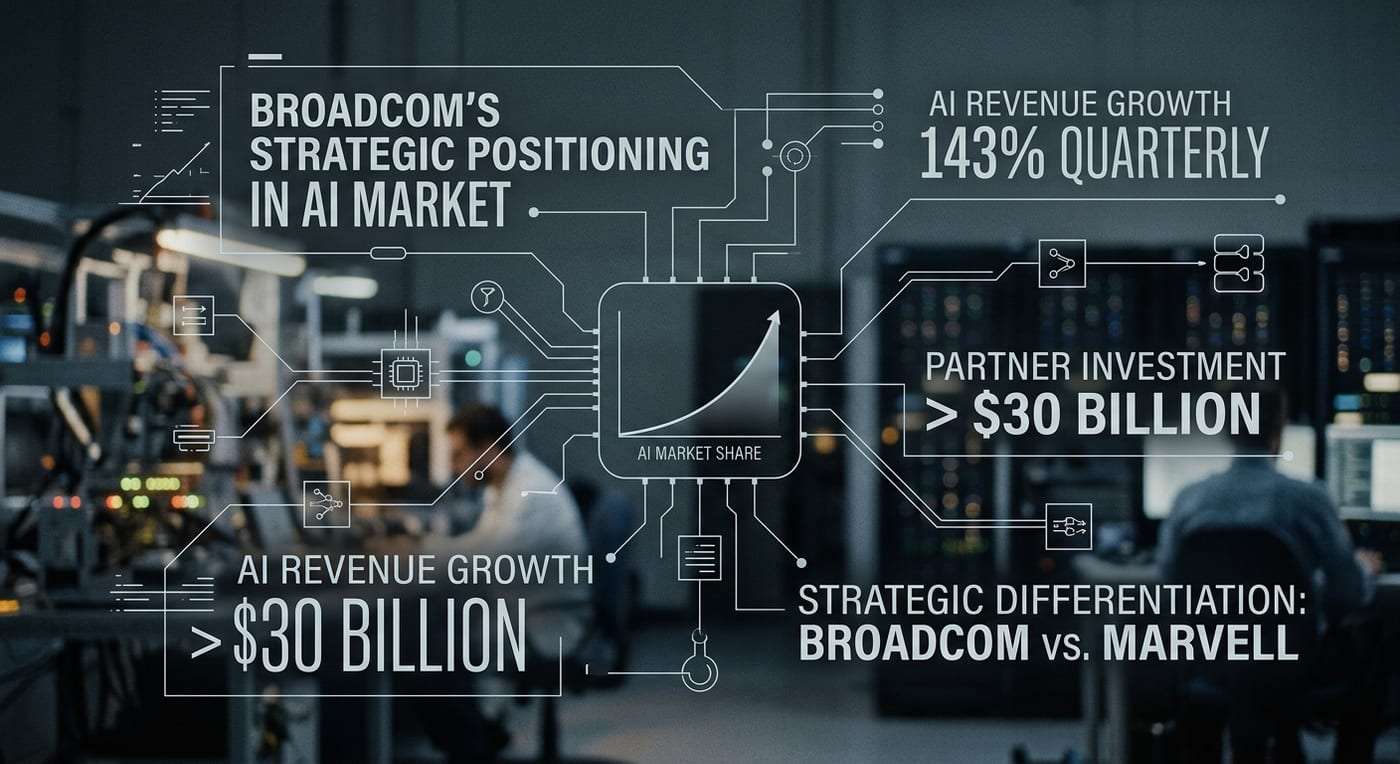
- Apple invests over $30 billion in Broadcom's technology.
- Broadcom's AI revenue grows 143% in one quarter.
- Comparison between Broadcom and Marvell highlights strategic differentiation.
Broadcom Inc. AVGOP is reshaping the landscape of the semiconductor industry under the mounting pressures and emerging opportunities spurred by advancements in artificial intelligence (AI). As the demand for bespoke AI solutions continues to rise, Broadcom has strategically aligned itself with key technology players, particularly through its recent dealings with Apple, tapping into a lucrative market that promises substantial returns. This comprehensive analysis delves into Broadcom's position relative to its competitors, its market strategy, and the implications of its current partnerships for future growth.
A Milestone Partnership with Apple
The recent collaboration between Broadcom and Apple marks a pivotal moment in their ongoing partnership, with Apple committing to a substantial $30 billion investment in Broadcom's custom chips and wireless connectivity technologies over the next several years. This commitment not only fortifies Broadcom's revenue prospects but also underscores a significant step towards increasing domestic production of advanced semiconductor technologies amid a global supply chain crisis. This relationship is grounded in the mutual goal of enhancing operational efficiencies and reducing reliance on non-domestic production sources, a strategic move that could prove beneficial as market dynamics evolve.
As noted in a previous article, Broadcom's partnerships have substantial implications, particularly as Apple is expected to manufacture more than 15 billion chips in the U.S., reaffirming the tech ecosystem's shift towards localized production to mitigate external risks associated with geopolitical tensions and supply chain disruptions. Furthermore, this partnership aims to advance the development of not just consumer technology but also robust networking capabilities critical for the burgeoning AI landscape.
Broadcom's Position in the AI Chip Market
Broadcom's growing focus on AI technology is noteworthy. Over the past quarter, the company reported a staggering revenue growth of 143% from its AI chip division, accumulating approximately $10.8 billion in AI revenue. Broadcom's strategy revolves around designing application-specific integrated circuits (ASICs) that cater to major players such as Google and Meta, a market segment that is expected to expand significantly as enterprises increasingly seek tailored solutions to optimize their operations.
In essence, while other companies such as Nvidia dominate the narrative surrounding AI chips, Broadcom has carved out a significant niche by providing customized solutions that appeal to hyperscalers—large cloud service providers that are transforming their operations to better integrate AI capabilities. A recent report suggested that Broadcom's AI revenue could skyrocket to $180 billion by 2028, likely indicating its robust pipeline and existing customer relationships.
Competitive Landscape: Broadcom vs. Marvell
When contemplating Broadcom's competitive positioning, a comparison with Marvell Technology becomes pertinent. While both companies are entrenched in the AI chip sector, they adopt different approaches toward market growth. Broadcom's established presence and diversification across semiconductor products and software services provide a steady revenue foundation amid fluctuating market conditions. In contrast, Marvell's aggressive growth strategy, characterized by continuous acquisitions targeting its optical interconnect technology, epitomizes a more concentrated business model that could yield faster growth—but at a higher valuation risk.
The divergence in their trading valuations signals how investors perceive growth trajectories and risks associated with these businesses. While Broadcom's commitment to a diversified offering—coupled with its expanding infrastructure software business post-acquisition of VMware—may cushion the effects of cooled segments within the AI market, Marvell's strategy hinges on rapid expansion and integration of new capabilities, positioning it as a vigorous contender to Broadcom's market dominance.
Future Outlook and Strategic Initiatives
Looking forward, Broadcom's strategic roadmap indicates an intent to solidify its leadership role within the AI chip market. With significant investments earmarked for modernizing production facilities and expanding its custom chip offerings, the company is well poised to capitalize on the anticipated ramp-up in AI infrastructure spending. Moreover, as organizations increasingly pivot towards AI-enabled solutions to boost operational efficiencies and drive competitive advantages, Broadcom's ability to deliver customized, high-performance products will be instrumental in maintaining its market relevance and shareholder value.
The initiative to partner with Apple could also open doors to potential collaborations with other players in the tech space, positioning Broadcom favorably as an indispensable ally in the semiconductor landscape. The increased agility in operations paired with innovative product offerings will be paramount as demand for AI solutions proliferates across sectors.
Conclusion
In summary, Broadcom Inc. AVGOP is strategically leveraging its partnerships and core competencies to navigate the evolving AI chip market successfully. With a focused approach on domestic production, collaboration with heavyweights like Apple, and a robust portfolio of custom ASIC solutions, Broadcom is shedding light on its path towards substantial growth. As market conditions evolve, its dual strategy of diversification while maintaining a strong customer-centric approach uniquely positions Broadcom for ongoing success in the competitive semiconductor arena. Investors maintain optimism that the company will continue to innovate and expand its influence within this critical sector of the technology landscape. The same pressure is reflected in recent reporting on the issue, which helps explain why the company's pricing decisions remain under scrutiny.