
Deutsche Bank Navigates ECB's Interest Rate Hike Amid Inflation and Economic Challenges
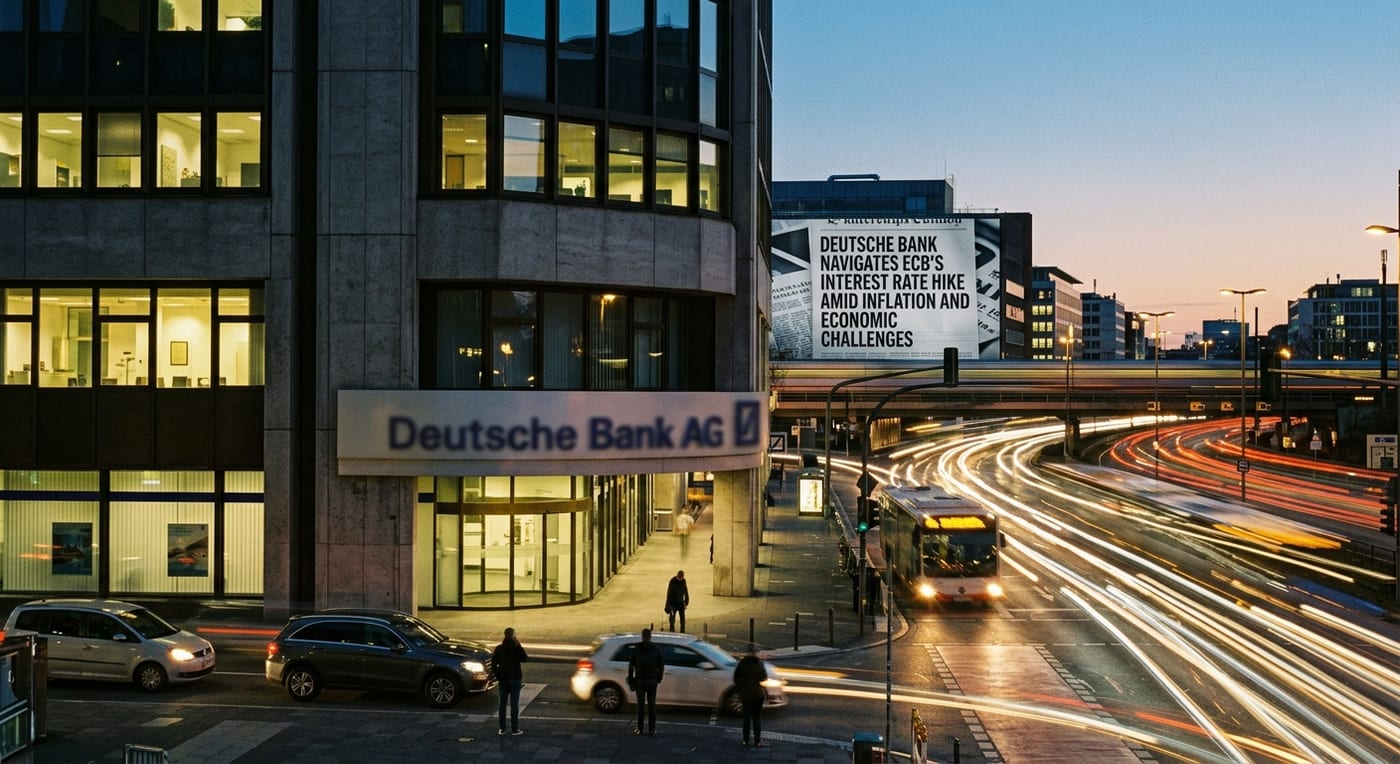
- Deutsche Bank AG faces challenges from ECB's planned interest rate hike to combat rising inflation and energy costs.
- Analysts suggest the ECB's tightening measures will impact Deutsche Bank’s lending practices and client relations moving forward.
- The financial sector, including Deutsche Bank, must adapt to geopolitical tensions and inflationary pressures for sustainable growth.
Deutsche Bank AG (DB) faces a challenging landscape as European Central Bank (ECB) President Christine Lagarde prepares to announce an interest rate hike aimed at combating inflation, influenced by rising energy prices. The ECB's strategy, remaining steadfast on its inflation target of 2%, is in stark contrast to the more flexible approach of the Federal Reserve. Recent inflation data reveals that the eurozone's headline inflation has surged to 3.2% in April, primarily due to a staggering 10.9% year-on-year increase in energy costs. This inflation surge raises critical issues for banks like Deutsche Bank, which operates within the European financial ecosystem heavily affected by these changes. The ongoing Iran conflict further complicates this scenario, highlighting the eurozone's dependence on energy imports and the resulting vulnerabilities that are expected to impact the broader economy.
Navigating Interest Rates and Inflation
As the ECB convenes to discuss monetary policy, analysts note that economic growth might face setbacks despite the necessity of tightening policies to address inflation. Deutsche Bank experts like Marc Wall express that the anticipated interest rate hike is unlikely to be a temporary measure. Instead, this decision may signal a long-term tightening trajectory for the ECB as it grapples with the repercussions of persistent core inflation, now rising to 2.5%. This situation underscores the importance of careful navigation for Deutsche Bank as it balances lending practices and client relations amid changing economic conditions.
The Broader Economic Context for Deutsche Bank
With the ECB likely to raise its key deposit rate by 25 basis points to 2.25%, market forecasts suggest that further increases could soon follow. The implications of these actions extend beyond monetary policy; they also play a crucial role for Deutsche Bank as it assesses lending rates, operational costs, and customer demand particularly in the context of a potentially slowing economy. Bank analysts are keeping a close watch on the ECB's stance regarding inflation forecasts, particularly core inflation, to gauge future implications for both bank profitability and economic stability in the eurozone.
Conclusion
While attention focuses on upcoming interest rate decisions from the ECB, the overall health of the eurozone economy and its repercussions for banks like Deutsche Bank remain pivotal. As the situation evolves, the interplay between monetary policy and economic growth will continue to shape the financial landscape in the region.
Related Cashu News

Main Street Capital Enhances Credit Facility to Boost Financial Flexibility and Investment Potential
Main Street Capital Corporation (Ticker: MAIN) has successfully amended its revolving credit facility to increase its financial capabilities. This development marks a significant step for the company,…

MarketAxess Launches TraX Tape to Enhance Bond Market Data Transparency and Efficiency
MarketAxess Holdings (Ticker: MKTX) continues to innovate in the bond market with the launch of TraX Tape, a new solution that aims to transform market data handling for institutional clients. The int…

Atlanticus Holdings Faces Challenges Post Removal from Key Russell Indices
Atlanticus Holdings (Ticker: ATLC) navigates significant challenges following its removal from multiple key Russell indices, including the Russell 2000 Value and Russell 3000 Value indices. This chang…

Arbor Realty Trust Raises $325 Million to Strengthen Financial Stability and Market Position
Arbor Realty Trust (Ticker: ABR) successfully completes a $325 million upsized offering of 6.25% Convertible Senior Notes, maturing in 2029. This significant capital raise is strategically designed to…