
IBM Faces Challenges Amid AI Spending Shifts
ED
Editorial
Cashu Markets·4 min read
TL;DR
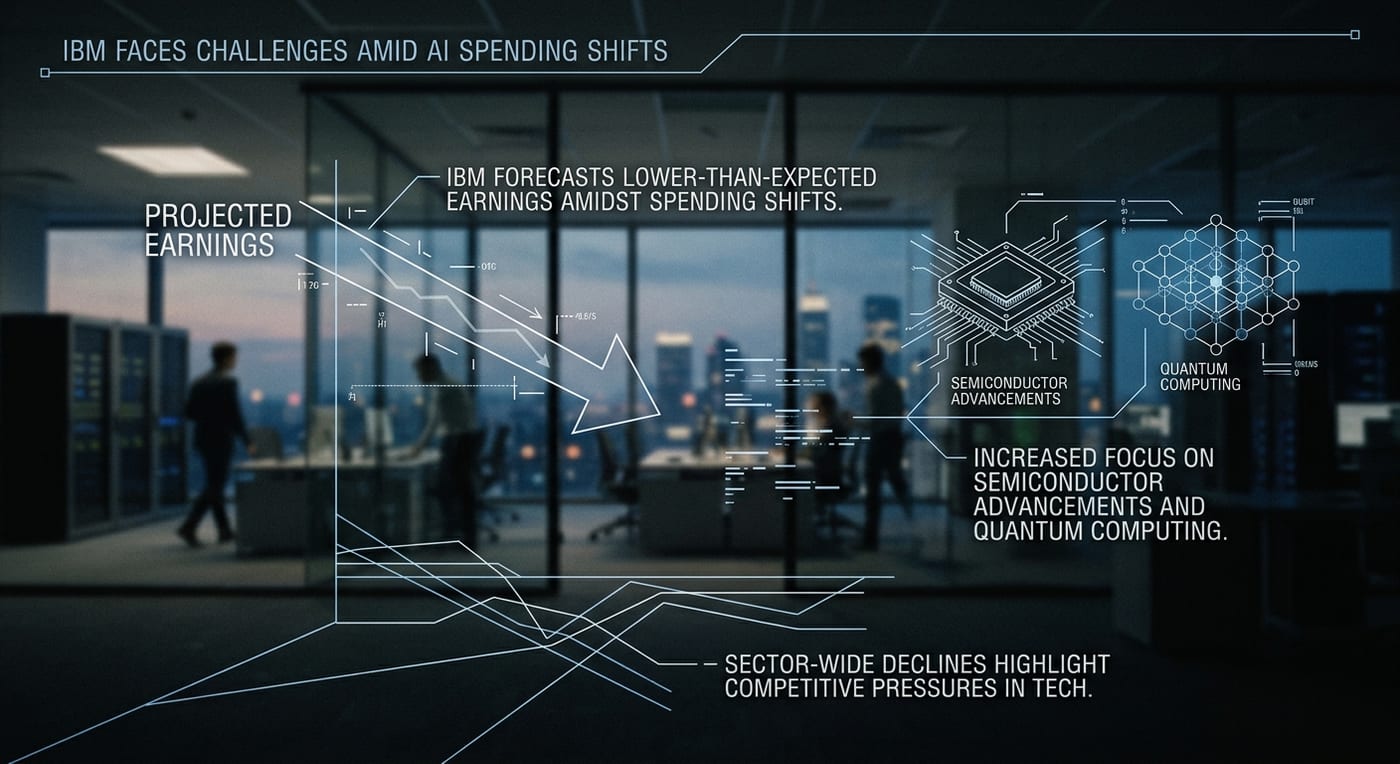
- IBM forecasts lower-than-expected earnings amidst spending shifts.
- Increased focus on semiconductor advancements and quantum computing.
- Sector-wide declines highlight competitive pressures in tech.
International Business Machines Corporation (IBM) is drawing attention as the latest developments come into focus. International Business Machines Corporation (IBM) is currently at a pivotal intersection, as it navigates through a rapidly evolving landscape fraught with increasing competition, economic shifts, and transformative technological advances.
IBMs recent financial disclosures have raised alarms among investors and analysts, particularly after the company forecasted second-quarter earnings that fell short of expectations. The tech giant reported adjusted earnings per share of $2.93, alongside revenues of $17.2 billion, both figures below analyst predictions. The downturn comes at a time when the market is buzzing with the explosive growth of artificial intelligence and data-center infrastructure, sectors that are changing how corporations allocate their technology budgets. This shift has notably impacted IBM's traditional software and hardware sales, leading to significant stock fluctuations.
Shifting Dynamics in Technology Spending
The increasing adoption of AI solutions and the requisite investment in data-center infrastructure have compelled many firms to pivot their spending priorities towards hardware rather than software, a trend that has not been favorable for IBM's core business. As observed by CEO Arvind Krishna, businesses are reallocating their capital expenditures to secure critical infrastructure components, anticipating potential price increases amid supply constraints. This pivot has generated a new landscape of competition, where tech leaders are competing not just on software development but also on hardware capabilities that support advanced technologies.
With these developments, many companies, including IBM, are now intensifying their focus on cybersecurity, recognizing that recent advancements in AI have heightened risks related to data security. For instance, organizations are ramping up their cybersecurity expenditures due to sophisticated AI-driven hacking threats, forcing IBM to adapt its product offerings to maintain a competitive edge in this space.
The Corporate Response to Financial Pressures
The critical moment for IBM is not just an isolated issue; rather, it reflects broader trends within the tech industry. Other notable firms, including Microsoft and ServiceNow, have also experienced declines in their stock prices, as investors grapple with the implications of these changes in corporate spending trends. The collective downturn casts a shadow over the entire sector, forcing more scrutiny onto IBM's financial trajectory.
In light of its recent challenges, IBM is striving to diversify its revenue streams and reduce its historical dependence on the cyclical mainframe business. The company has made considerable investments into its software unit, prominently featuring Red Hat, aiming to help organizations boost their operational flexibility across different cloud platforms. This diversification strategy is crucial as IBM seeks to maintain margins amid fluctuating demand for software solutions.
IBM’s Advancements in Quantum Computing
Despite these headwinds, IBM is strategically investing in groundbreaking technology domains. The company recently unveiled groundbreaking advancements in chip technology with the introduction of its sub-1 nanometer chip architecture, known as 'nanostack'. This new chip design, integrating around 100 billion transistors, promises significant improvements in performance and energy efficiency. Such innovations may act as a beacon of hope for IBM, potentially reshaping its trajectory in the high-performance computing landscape.
The investment in quantum computing, which has topped $10 billion, highlights its commitment to lead in emerging technology sectors. The sub-1 nanometer chips are essential as they target industries increasingly dependent on cutting-edge applications like AI and cloud computing. For instance, as detailed in another article, 'IBM Unveils Breakthrough Sub-1 Nanometer Chip and Quantum Wafer Foundry for Future Growth' (https://cashumarkets.com/articles/1881377b2ed7212868d37073d9551abf82f97ccf), these advancements position IBM to reclaim its foothold in high-stakes technological arenas.
A Long-Term Investor Perspective
Investors are undoubtedly anxious regarding the future performance of IBM, especially considering it recently forecasted only a 1% revenue rise for the second quarter, underlining concerns that IBM's historical market position could be under threat. The company must strike a balance between investing in transformative technologies like quantum computing while managing short-term financial pressures stemming from decreased demand for traditional software solutions.
Furthermore, as corporations increasingly seek solutions that combine integrated software capabilities with robust cybersecurity measures, IBM's challenge lies in adapting rapidly to these evolving needs. Investors may find that navigating this changing landscape requires patience and foresight, and it will be critical to monitor IBM’s ability to close major deals and pivot towards growth sectors effectively.
Conclusion
In conclusion, while IBM is facing substantial challenges related to shifting corporate spending patterns and the stringent competitive landscape, its ongoing investments in quantum computing and semiconductor development suggest a robust approach to future-proof its operations. Nonetheless, sustaining investor confidence will hinge on IBM's operational execution in the near term. Stakeholders should closely watch how the tech giant manages to pivot towards these new opportunities even while addressing pressing operational pressures. The same pressure is reflected in recent reporting on the issue, which helps explain why the company's pricing decisions remain under scrutiny.