
MKS Instruments Surges in Q1 as Semiconductor Demand Grows Amid AI Advancements
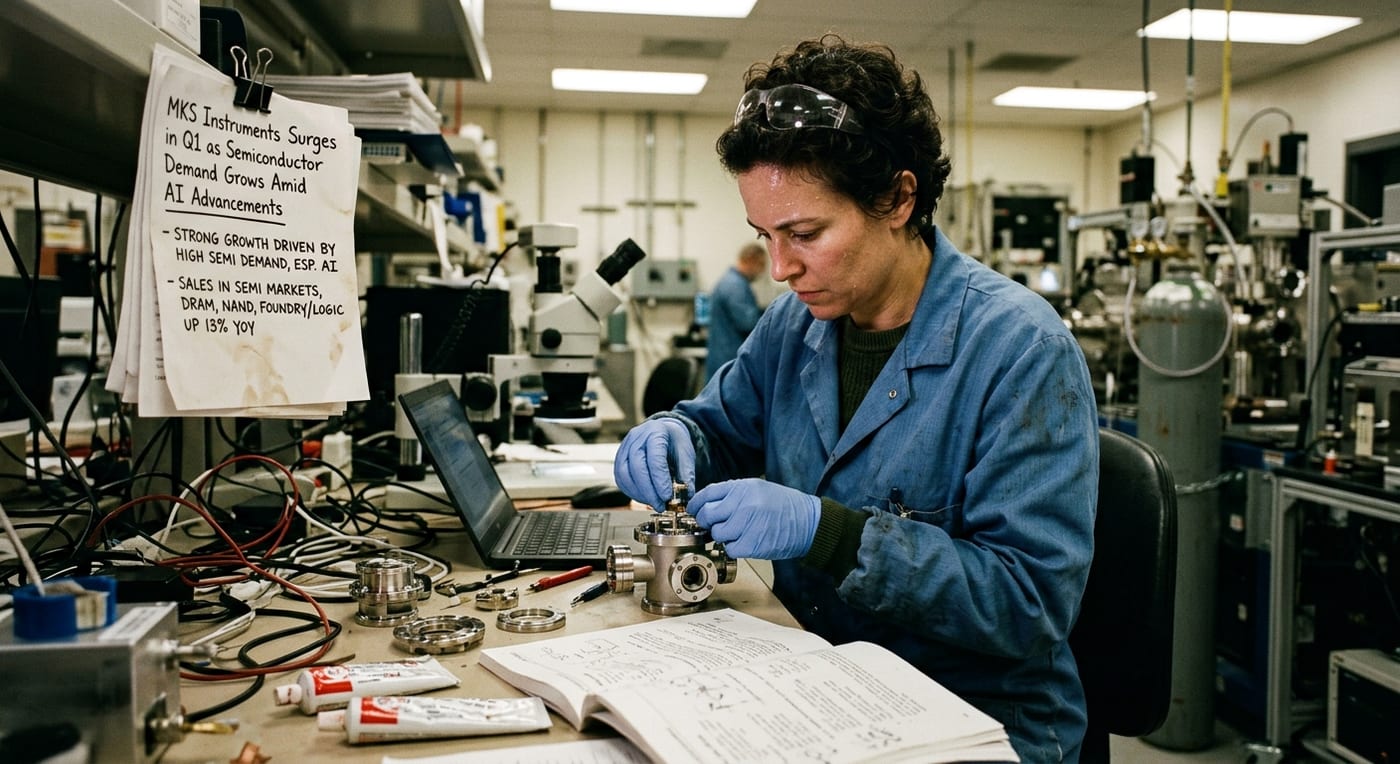
- MKS Instruments shows strong growth due to high demand in the semiconductor sector, especially driven by AI technologies.
- The company exceeded market expectations with significant revenue and earnings per share in the first quarter.
- Sales in semiconductor markets, including DRAM, NAND, and foundry/logic, rose 13% year-on-year, highlighting AI's influence.
MKS Instruments (MKSI) demonstrates robust growth driven by substantial demand in the semiconductor sector, particularly due to AI technologies, as evidenced by its recent first-quarter financial results.
Strong Q1 Results Highlight Growth Potential
The company's earnings per share and revenues significantly exceed market expectations, showcasing a 13% year-on-year increase in sales within the semiconductor markets, which include DRAM, NAND, and foundry/logic segments. This surge underscores the critical role that advancements in artificial intelligence are playing in driving investments and revenue opportunities within these industries.
Moreover, MKS Instruments provides an optimistic outlook for the upcoming second quarter, reflecting management's confidence in sustained revenue and earnings improvements. This strong performance can be attributed to the ongoing trend of increasing AI-related investments, which are expected to further bolster the company's growth trajectory in the near term.
Positive Market Response Reflects AI Demand
With solid Q1 results and positive projections for Q2, MKS's performance indicates a healthy response to evolving market demands spearheaded by AI advancements. The continued expansion in the semiconductor sector aligns with MKS's strategic focus on innovative solutions and technologies that address the increasing complexities of AI applications.
Related Cashu News

Photronics Faces Earnings Challenges Amid Investigation and Market Pressures
In recent days, Photronics (Ticker: PLAB) faces intensified scrutiny following its second-quarter earnings report, revealing ongoing challenges in the semiconductor manufacturing landscape. The compan…

ON Semiconductor Launches Elite Pairing Studio to Enhance Power Electronics Design Process
ON Semiconductor (Ticker: ON) unveils a groundbreaking tool for engineers with the launch of its Elite Pairing Studio, which significantly enhances the design process for critical power electronics co…

AXT Inc. to Double Production Capacity Amid Growing AI and Semiconductor Demand
AXT Inc. (Ticker: AXTI) gains notable traction in the semiconductor sector through its key production of indium phosphide substrates, which are integral to the growing artificial intelligence (AI) and…

TSMC Expands 3nm Chip Production Amid Strong Demand and Order Backlogs
Taiwan Semiconductor Manufacturing Company (Ticker: TSM) has taken significant steps to address the burgeoning demand for advanced semiconductor technology, particularly with its recent expansion of 3…