
Moleculin Biotech's Annamycin Shows Promise in Treating Relapsed/Refractory Acute Myeloid Leukemia
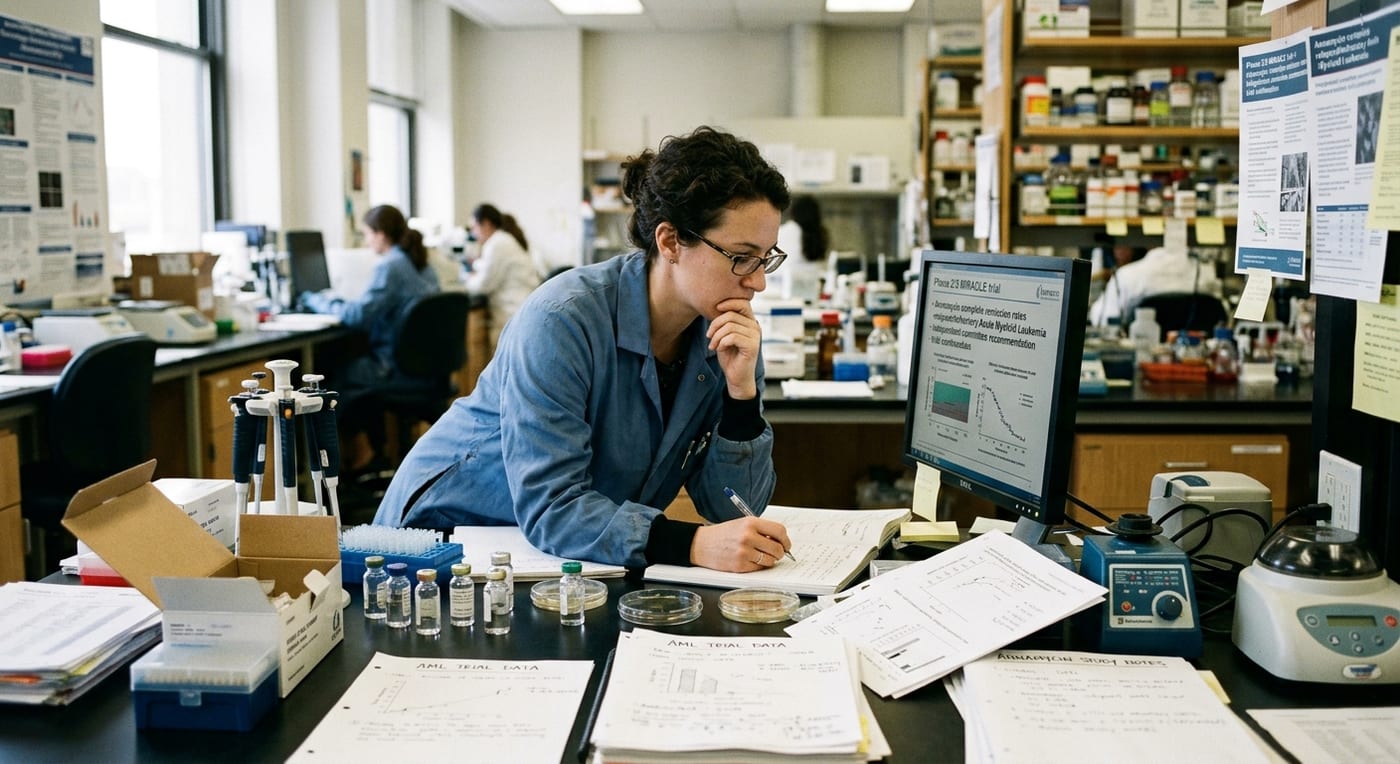
- Moleculin Biotech is exploring Annamycin for relapsed/refractory acute myeloid leukemia, showing promising trends despite not reaching statistical significance.
- The Phase 2/3 MIRACLE trial reports higher complete remission rates for Annamycin compared to control treatments.
- An independent committee recommends continuing the trial, emphasizing the thorough evaluation of Annamycin's market potential before conclusions.
Moleculin Biotech continues to advance its clinical exploration of Annamycin in treating difficult cases of leukemia, focusing on relapsed or refractory acute myeloid leukemia (R/R AML). Recent developments from the Phase 2/3 MIRACLE trial indicate promising trends, despite preliminary efficacy data not reaching statistical significance. This underscores the importance of ongoing research in combatting aggressive cancer types, particularly in older patients who may have limited treatment options. The trial assesses Annamycin alongside traditional therapies, highlighting a potential integration of innovative compounds in established treatment paradigms.
The results from the MIRACLE trial reveal encouraging complete remission (CR) rates for the Annamycin cohorts compared to the control group. Specifically, the CR rates show a notable increase in the treatment arms, 43% for the 190 mg/m² Annamycin plus high-dose cytarabine and 36% for the 230 mg/m² combination versus just 12% in the HiDAC control. The overall 50% and 57% composite remission rates for the Annamycin groups further point towards significant biological activity, particularly in a population heavily affected by prior treatment complications.
An independent monitoring committee has recommended that Moleculin Biotech proceed with the study without alterations. This decision is crucial, emphasizing the trial's design, which delays the main testing power until the final analysis. This approach aligns with scientific prudence in clinical trial management, ensuring that the investigational drug is thoroughly evaluated before determining its market viability. As the company moves forward with its research, it remains focused on addressing unmet medical needs in treating R/R AML, especially among older patients with complex health backgrounds.
In parallel to these developments, the commitment to rigorous scientific investigation positions Moleculin Biotech favorably within the oncology sector. The focus on older adults, who represent a significant portion of the R/R AML patient population, highlights a critical demographic that requires tailored therapeutic strategies. Their ongoing efforts could catalyze advancements in cancer treatment methodologies, contributing to better patient outcomes in a challenging therapeutic landscape. As the study continues, the industry watches closely for further insights into the viability of Annamycin as a new option for clinicians and patients alike.
Related Cashu News

Bristol-Myers Squibb's Reclassification Enhances Growth Potential in Defensive Investment Strategy
Bristol-Myers Squibb Company (Ticker: BMY) undergoes a key reclassification across the Russell indexes, marking a transformative moment for the company. Moving to the Russell 1000 Defensive and Russel…

Vertex Pharmaceuticals' Casgevy Gains FDA Approval for Expanded Sickle Cell Disease Treatment Options
Vertex Pharmaceuticals (Ticker: VRTX) receives a significant boost in its ongoing battle against sickle cell disease with the recent FDA approval of an expanded label for its gene therapy product, Cas…

Gilead Sciences Gains FDA Approval for Trodelvy in First-Line Triple-Negative Breast Cancer Treatment
Gilead Sciences (Ticker: GILD) makes significant strides in oncology therapy with the recent approval of its drug Trodelvy for patients with unresectable or metastatic triple-negative breast cancer. T…

Merck Advances HIV Treatment and Faces Regulatory Scrutiny Amidst Market Success
Merck & Co. (Ticker: MRK) has recently made significant strides in the pharmaceutical landscape, particularly with its advancements in HIV treatment. The company's innovative drug, IDVYNSO, has receiv…