
NVIDIA's Challenges in the Chinese Market Amid Geopolitical Tensions and Regulatory Struggles
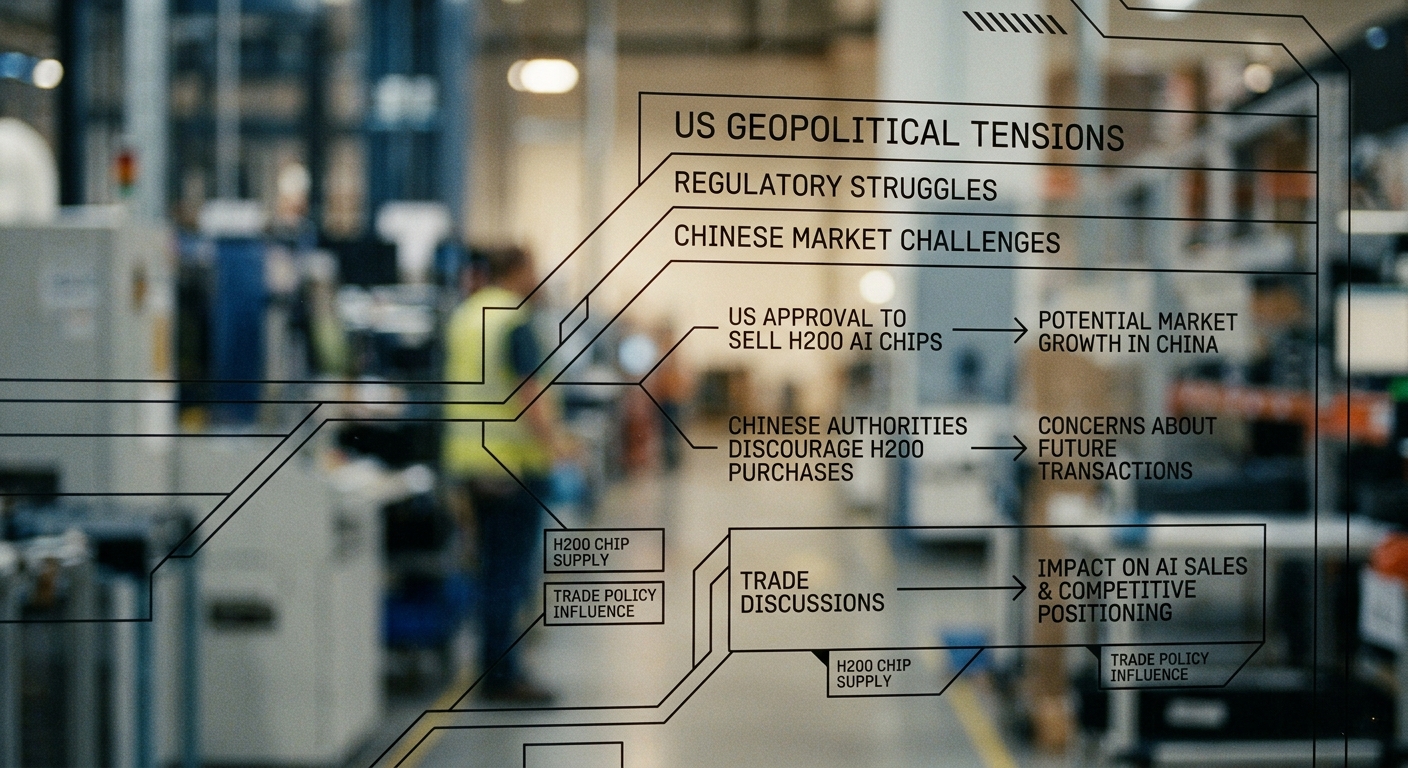
- NVIDIA received U.S. approval to sell H200 AI chips to major Chinese tech firms, indicating potential market growth.
- Chinese authorities have discouraged local firms from purchasing H200 chips, raising concerns about NVIDIA's future transactions in China.
- CEO Jensen Huang's trade discussions highlight NVIDIA's role in U.S.-China relations, impacting sales and competitive positioning in AI.
NVIDIA Corporation (NVDA) is making pivotal moves in navigating the complexities of the Chinese market. The U.S. Commerce Department's recent decision permitting NVIDIA to sell its H200 AI chips to several major Chinese technology companies signals potential growth for NVIDIA in a crucial market. However, this approval arrives amid a backdrop of rising geopolitical tensions and regulatory scrutiny. Notably, shortly after this approval, Chinese authorities discouraged local firms from proceeding with purchases of the H200 chips, raising concerns among investors about future transactions and NVIDIA's market access in China. CEO Jensen Huang's participation in high-level trade discussions has previously stirred expectations regarding improved sales prospects; however, tangible progress remains uncertain as actual orders have not yet materialized. As the company prepares to report its quarterly earnings, analysts and investors are closely monitoring the implications of these developments on NVIDIA's performance and its competitive position within the rapidly evolving AI landscape.
This decision allows NVIDIA to penetrate a market that holds considerable promise for expansion, especially considering China's ambitions in artificial intelligence and computing technology. Despite the U.S. regulatory green light, the hesitance of Chinese companies to move forward emphasizes the dual-edged nature of these developments. The broader implications include potential challenges back home as well, where the increasing intricacies of U.S.-China relations could impact NVIDIA’s strategic operations for years to come. Huang's presence in diplomatic engagements underscores the importance of technology companies in broader geopolitical dialogues, making NVIDIA's situation a key indicator of future trends in U.S.-China tech relations.
As NVIDIA prepares to discuss its financial results, stakeholders are particularly interested in how these geopolitical factors may influence its outlook. Anticipation is building around the prospects of sales growth driven by AI demand and significant partnerships. Yet, the uncertainties in China weigh heavily on the company's immediate future, as successful navigation of these market challenges is critical for sustaining NVIDIA's leadership in AI technologies. Overall, NVIDIA's ability to adapt and respond to these global dynamics could define the company's trajectory in the months and years to come.
Related Cashu News

Quantum eMotion Corp Partners with Vertical Data to Enhance Cybersecurity Using Quantum Technology
Quantum eMotion Corp (Ticker: QNC.NE) partners with Vertical Data to bolster cybersecurity in GPU clusters through quantum-entropy techniques. This collaboration is a response to the mounting demand f…

Himax Technologies Innovates with T2000 Color ePaper for Enhanced Digital Signage Solutions
Himax Technologies (Ticker: HIMX) continues to make notable strides in the display technology sector with its latest integration success, which could pave the way for future growth. Recently, the comp…

JinkoSolar Announces Cash Dividend, Reflecting Confidence in Future Growth and Shareholder Value
JinkoSolar Holding Co. (Ticker: JKS) announces a commitment to shareholder value through a new cash dividend, underscoring its confidence in future growth. The company's board of directors has approve…

ASML's Crucial Role in Semiconductor Industry Highlighted by Musk Amidst Growing Chip Demand
ASML Holding NV (Ticker: ASML) has become a focal point in the semiconductor industry, thanks in part to its exclusive production of extreme ultraviolet (EUV) lithography machines, which are crucial f…