
NVIDIA's Unstoppable AI Domination
ED
Editorial
Cashu Markets·5 min read
TL;DR
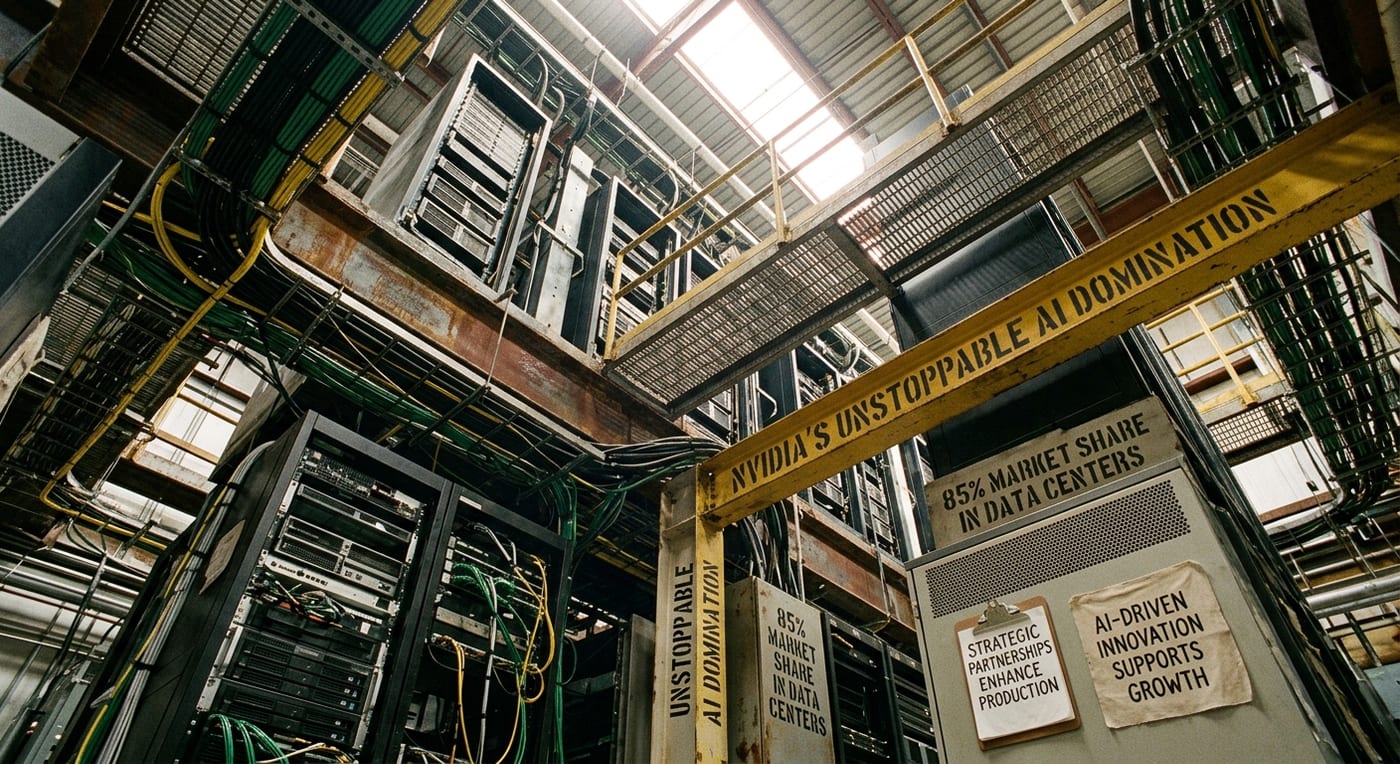
- NVIDIA retains an 85% market share in AI data centers.
- Strategic partnerships enhance production capabilities amid rising demand.
- Innovation in AI-driven technologies supports continuous growth prospects.
NVIDIA Corporation (NVDA) stands at the forefront of the artificial intelligence (AI) industry, positioning itself as the unequivocal leader thanks to its cutting-edge technology and strategic initiatives. With a staggering 85% market share in AI data centers, NVIDIA is uniquely positioned to benefit from the explosive demand for AI capabilities across various sectors, including healthcare and finance. This article delves deep into NVIDIA's transformative journey, its ongoing innovations, and the challenges it faces amid a rapidly evolving technological landscape.
The Ascendance of NVIDIA in AI
As organizations worldwide increasingly integrate AI into their operations, the role of NVIDIA's high-performance graphics processing units (GPUs) becomes even more critical. The AI infrastructure boom has led to a race among tech giants to procure Nvidia’s advanced products. With major hyperscale clients spending enormous amounts to enhance their computing capabilities, NVIDIA continues to deliver innovative solutions that keep it a step ahead of competitors. Recent partnerships, like the collaboration with Silvaco to advance physics-based digital twins for semiconductor design and manufacturing using NVIDIA’s accelerated computing and AI, underscore the company’s commitment to driving technological advancements while meeting burgeoning demand.
The recent announcement of NVIDIA's collaboration sets a new standard, as it combines decades of Silvaco's physics modeling expertise with NVIDIA’s AI and accelerated computing capabilities. This partnership will create high-fidelity digital twins capable of optimizing complex semiconductor designs, enabling clients to innovate rapidly and effectively.
Hyper-Demand for AI Solutions
The insatiable demand for AI technologies fuels NVIDIA's growth trajectory. Companies across various industries are increasingly turning to AI-driven solutions to enhance efficiency and improve decision-making. For instance, a recent analysis projected that global data center capital expenditures could reach between $3 trillion and $4 trillion annually by 2030. Such predictions validate the immense need for high-performance GPUs, which position NVIDIA favorably in capturing a significant market share amidst this growth. Furthermore, NVIDIA's ongoing efforts to innovate, exemplified by the upcoming launch of its Vera Rubin architecture, promise to broaden its already extensive array of products and services tailored for the AI ecosystem. As tech giants like Alphabet, Amazon, and Microsoft expand their operations, NVIDIA continues to be the preferred provider for critical computing resources.
Strategic Partnerships and Collaborations
NVIDIA's approach to cementing its market position includes forging strategic partnerships that enhance its capabilities while mitigating challenges associated with supply constraints. A noteworthy example is NVIDIA's recent agreement with SK Hynix, valued at an estimated $500 billion, to secure AI memory supply essential for its advanced processors. This deal aims to construct large-scale data centers projected to come online in 2027, demonstrating NVIDIA’s proactive strategy to bolster its supply chain while anticipating future growth demands in the AI sector.
As Raj Mirpuri, NVIDIA's enterprise vice president, noted, this collaboration will not only provide a stable supply of high-bandwidth memory but will also mark an essential step in the global AI infrastructure buildout. The collaborative efforts with SK Hynix underline NVIDIA's strategy to innovate in the face of evolving market dynamics while ensuring the ready availability of essential components for its product lineup.
Navigating Challenges and Market Expectations
While NVIDIA's trajectory appears overwhelmingly positive, several inherent challenges persist that may impact its growth trajectory. For instance, the semiconductor industry faces a cyclical nature prone to supply shortages and fluctuating demand cycles. Coupled with ongoing concerns related to geopolitical tensions—particularly with China—these factors may introduce complexities that NVIDIA needs to navigate carefully.
Additionally, as competitor products, including custom chips from large clients, emerge, NVIDIA must remain agile to maintain its leading market position. The current landscape also indicates an increased scrutiny of tech spending in AI infrastructure due to rising economic uncertainties, which may temper growth projections in the short term.
Investor Outlook and Future Prospects
Despite these challenges, investor sentiment remains largely optimistic about NVIDIA's potential for long-term growth. The company's remarkable financial performance, including record revenues exceeding $215 billion and profits reaching $120 billion in the latest fiscal year, exemplifies its capacity to yield substantial returns. Industry analysts and projections suggest that NVIDIA stock could potentially reach $800 per share by 2030, fueled by the anticipated increase in global AI spending and sustained demand for advanced computing solutions.
In light of the ongoing AI expansion, NVIDIA retains its reputation as a leading stock choice in the technology sector. Its commitment to innovation, coupled with a solid governance structure that affords significant transparency to shareholders, contrasts sharply with competitors like SpaceX, which operate under more consolidated ownership structures.
In conclusion, NVIDIA Corporation has not only established itself as a cornerstone of the AI landscape but continues to leverage strategic partnerships and innovative technologies to navigate the complex challenges ahead. With the AI market forecasted to flourish further, NVIDIA's ongoing endeavors will likely cement its dominance and yield robust returns for its stakeholders. The same pressure is reflected in recent reporting on the issue, which helps explain why the company's pricing decisions remain under scrutiny.