
Paccar Shifts Focus to Service-Driven Revenue Amid Declining Truck Deliveries and Growing Backlog
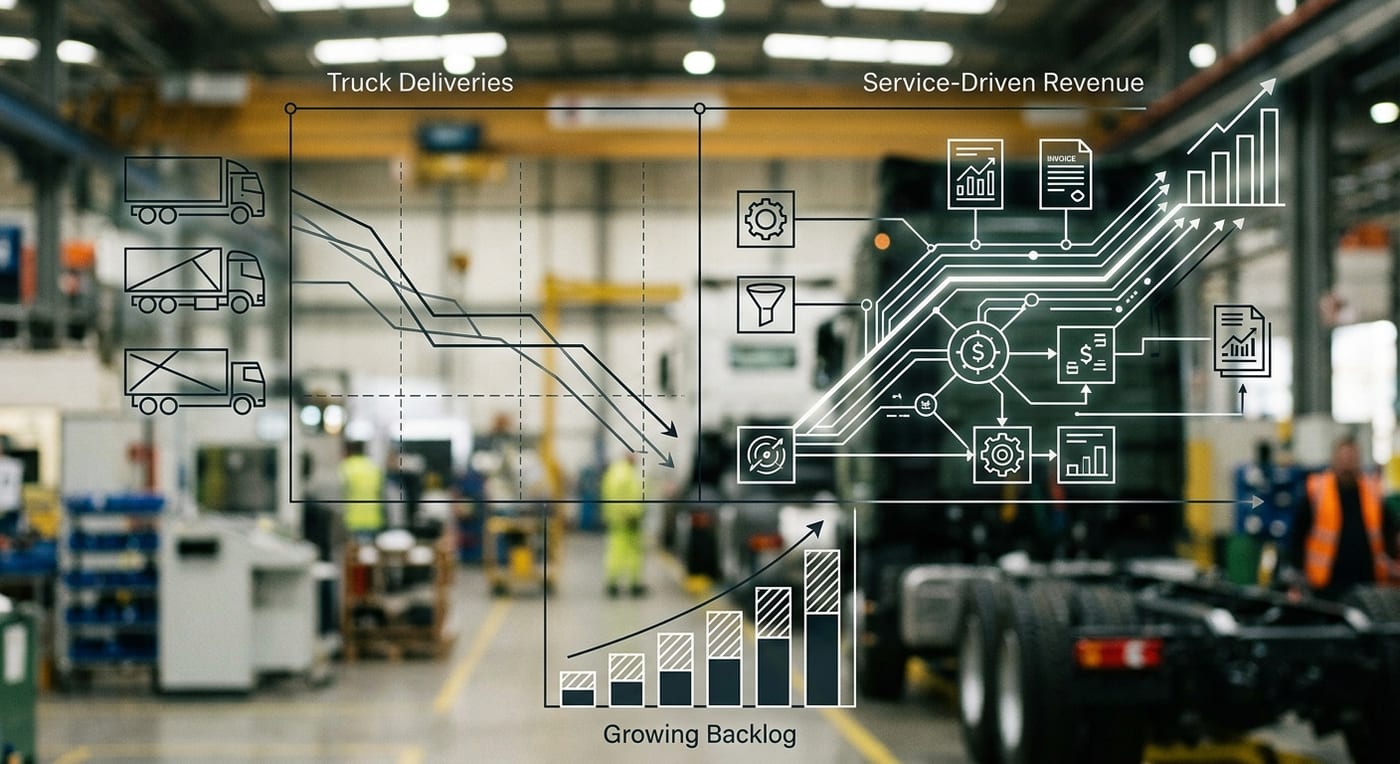
- Paccar reports increased net income driven by growth in parts and financial services despite declining truck deliveries.
- The company shifts focus from truck sales to diversify revenue, enhancing its resilience against market fluctuations.
- Paccar’s growing production backlog and service-oriented strategy position it well for future growth and sustained profitability.
Paccar (PCAR) demonstrates a significant shift in its business model as recent first-quarter results indicate an increase in net income driven by strong performance in its parts and financial services sectors. While the company experiences a decline in truck deliveries, its disciplined production strategies allow it to maintain alignment between capacity and demand. This careful management is apparent in Paccar's growing production backlog, suggesting a robust potential for future growth as it capitalizes on service-oriented revenue streams.
Diversification Strengthens Revenue
The company's strategy to diversify revenue away from traditional truck sales is particularly noteworthy, as it increasingly relies on its parts and financial services to bolster earnings. This shift not only reflects a proactive adjustment to changing market conditions but also positions Paccar in a more insulated stance against the cyclical nature of the truck market, which often experiences significant fluctuations. Analysts are keenly observing how these changes might influence Paccar's investment climate as it aligns itself with broader industry trends.
Future Growth Potential
As Paccar navigates through a challenging market landscape, its emphasis on expanding service-oriented solutions appears to be a forward-thinking approach aimed at mitigating risks associated with conventional truck sales. Moving forward, the company’s ability to sustain and grow its services business will be crucial to maintain its competitive edge and promote sustained profitability. With the production backlog indicating interest in future deliveries, stakeholders are optimistic about Paccar’s resilience in adapting to shifting consumer demands and steering towards a more diversified portfolio.
Industry Trends and Implications
In addition, Paccar’s focus on improving service performance reflects a significant industry trend where manufacturers seek to create more value outside of just selling trucks. As the company develops its financial services and parts segments, it opens new avenues for revenue that can help buffer against the cyclicity typically seen in heavy truck sales. On another note, as analysts evaluate the impact of these shifts on overall investment strategy, the performance in financial services may garner increased attention for its long-term implications as well.
Related Cashu News

Lockheed Martin Advances AI, Autonomy, and Space Exploration for Enhanced Military Operations and Safety
Lockheed Martin (Ticker: LMT) is making significant strides in integrating artificial intelligence and autonomy to enhance the efficiency and safety of military operations. The company focuses on deve…

AeroVironment Reports 133% Revenue Growth Amid Rising Military Demand for UAVs
AeroVironment (Ticker: AVAV) has emerged as a leader in the unmanned aerial vehicle (UAV) industry, particularly amidst a heightened global focus on defense technologies. The company has achieved subs…

AZZ Inc. Earnings Report Could Impact Stock Volatility and Dividend Investor Sentiment
AZZ Inc. (Ticker: AZZ) positions itself strongly in the industrial sector with its upcoming earnings report, reflecting its financial health and dividend strategy. Scheduled for release on July 8, the…

Astronics Signs Long-Term Deal with Vertical Aerospace for Valo eVTOL Power Systems
In late June 2026, Vertical Aerospace establishes a long-term agreement with Astronics Corporation (Ticker: ATRO) to supply the low-voltage power distribution system for its Valo eVTOL aircraft. This…