
Palantir's Strategic Rise Amidst Challenges
ED
Editorial
Cashu Markets·4 min read
TL;DR
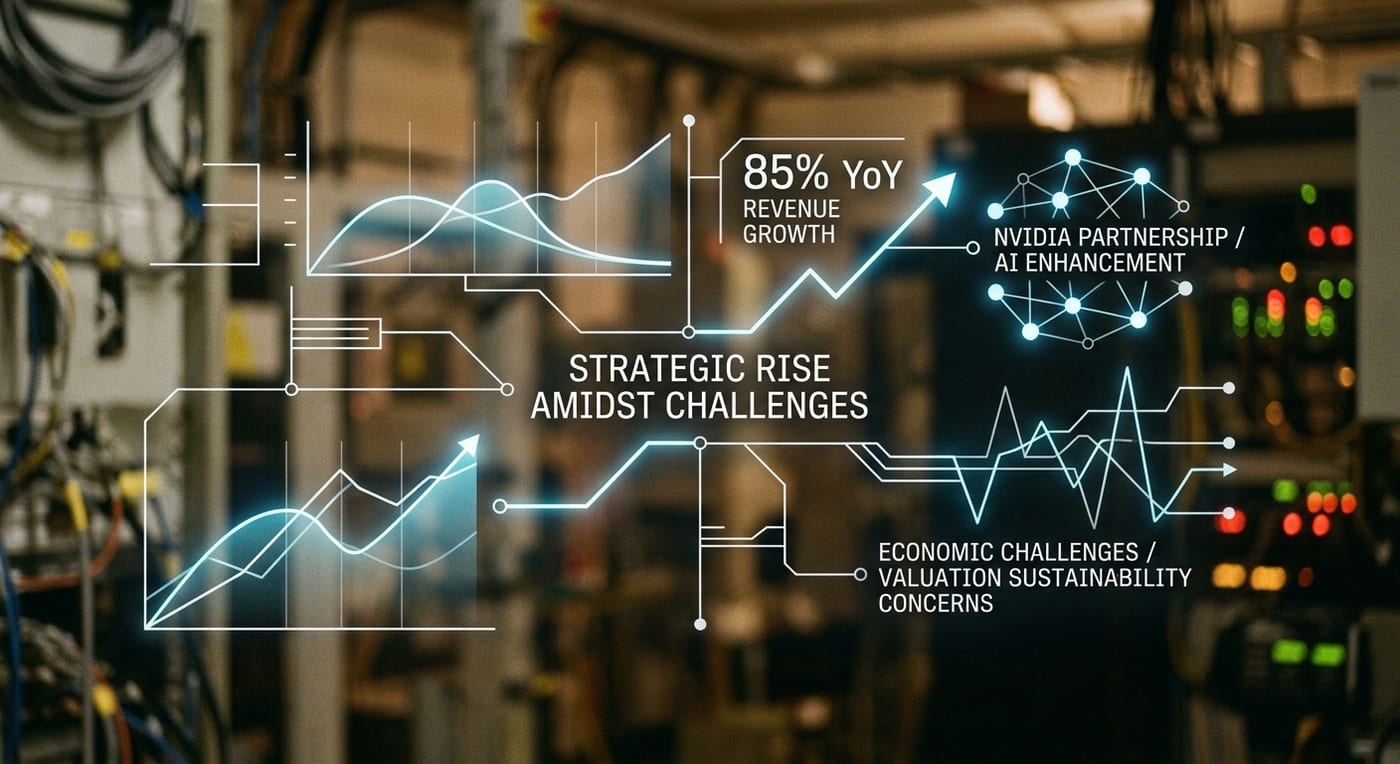
- Palantir reports an 85% year-over-year revenue growth.
- Strategic partnership with Nvidia enhances AI capabilities.
- Economic challenges raise investor concerns about valuation sustainability.
Palantir Technologies Inc. (PLTR) is drawing attention as the latest developments come into focus. Palantir Technologies Inc. (PLTR) is making significant strides in the technology sector, leveraging its unique capabilities in data analytics and artificial intelligence to navigate a complex economic landscape. The company is witnessing substantial revenue growth while simultaneously facing challenges that could impact its valuation and market perception. This article delves into Palantir's recent financial performance, strategic partnerships, and the macroeconomic environment influencing its trajectory.
Financial Performance Highlights
Palantir's robust revenue growth positions it uniquely within the tech industry. The recent quarterly report underscores a thriving commercial segment which is vital for its future growth potential. However, the wider market has initiated a sell-off in technology stocks, raising questions about whether Palantir can maintain its momentum. Much like other enterprise software companies, Palantir faces heightened scrutiny over its valuation. Analysts have expressed mixed sentiments, particularly as the company trades at around 145 times its earnings, which some investors view as excessive.
While Palantir’s financial performance is commendable, the environment is fragile. The strategic partnerships, notably with Nvidia, enhance its capabilities in AI, a sector where competition is intensifying quickly. The collaboration with Nvidia aims to provide state-of-the-art AI capabilities primarily for government use, catering to a demand that looks set to escalate due to increased reliance on AI technologies across public sectors. This partnership ties back to Palantir’s commitment to cutting-edge technology and innovation as a core part of its business strategy. As discussed in previous analyses, the alliance has the potential to bolster Palantir's standing as a leader in the AI domain, despite ongoing economic uncertainties.
Navigating Economic Challenges
The economic landscape remains a significant concern for investors. Recent tariffs and global trade tensions could impact not only Palantir but the broader technology sector. As highlighted in earlier reports, Palantir's reliance on U.S. government contracts means that any shifts in government spending could directly affect its revenue streams. An escalation in trade disputes could further complicate its operations and have repercussions for its project timelines. The concerns around a possible economic downturn echo throughout investor discussions, creating a backdrop of caution.
Moreover, as U.S. tech companies brace themselves against potential regulatory measures, Palantir's CEO Alex Karp has openly discussed the need for the U.S. to avoid excessive restrictions on the AI industry. Karp's advocacy for an open-weight approach to AI models aims to ensure that American companies remain competitive, as barriers could stifle innovation at a critical juncture for the sector. In contrast, European models, which may impose stringent regulations, could lead to unintended consequences for technological advancement and competitiveness. Karp’s perspective reinforces Palantir's commitment to leveraging AI responsibly while pushing for a supportive regulatory framework.
The Path Ahead
Looking forward, Palantir's future hinges on its ability to transform its technological innovations into consistent revenue streams. The growing interest in AI within government and commercial sectors indicates promising avenues for growth. However, the company must navigate an intricate web of challenges that includes potential overvaluation and investor skepticism. As financial analysts have noted, Palantir remains closely watched as it uncovers how quickly it can deploy its agentic AI technologies into the enterprise landscape.
While investors grapple with valuation concerns, the broader expectation for earnings growth remains relatively high, despite the mixed signals coming from the tech market. Predictive analytics suggest that the stock might see fluctuations post-earnings, reflecting ongoing recalibrations of investment strategies in the technology sector.
As Palantir Technologies continues to build on its strategic collaborations and robust financial performance, it will need to ensure that it adapts effectively to the evolving market landscape. The intersection of technological prowess and economic prudence will be crucial as the company seeks to cement its position as a leader in AI and data analytics, responding proactively to both opportunities and challenges that arise. The same pressure is reflected in recent reporting on the issue, which helps explain why the company's pricing decisions remain under scrutiny.