
Qualcomm: Navigating Supply Challenges and AI Expansion
ED
Editorial
Cashu Markets·5 min read
TL;DR
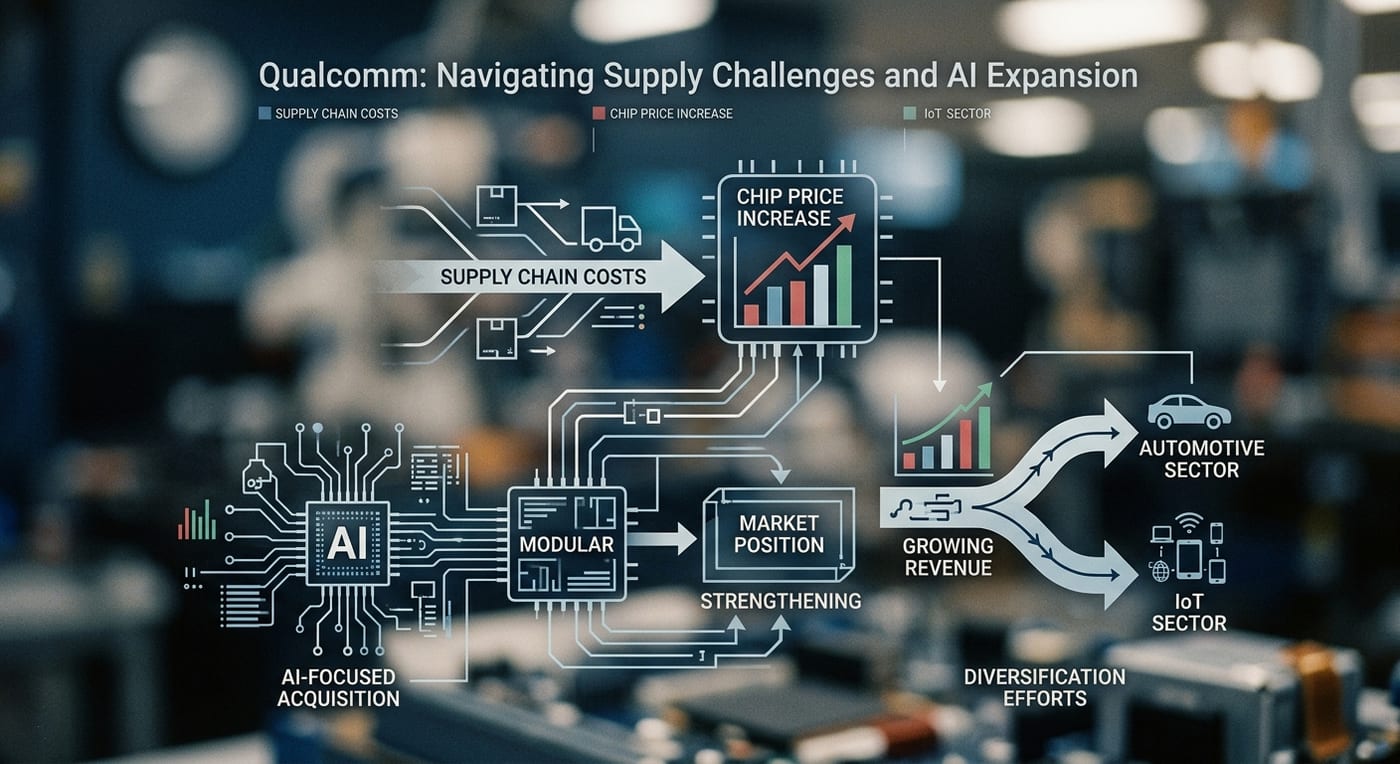
- Qualcomm is raising chip prices to counteract supply chain costs.
- The company's AI-focused acquisition of Modular aims to strengthen its market position.
- Growing revenue from automotive and IoT sectors highlights diversification efforts.
QUALCOMM Incorporated (QCOM) is strategically maneuvering through the complexities of the semiconductor market while simultaneously charting a course towards enhanced AI capabilities. As the company deals with the current memory supply crunch affecting many tech industries, it is also positioning itself for future growth through acquisitions and advancements in technology. This article explores Qualcomm's current financial status, the challenges it faces, and the innovative paths the company is pursuing in the rapidly evolving AI landscape.
Current Financial Landscape
Recent earnings reports highlight Qualcomm's ongoing struggles as it adapts to the volatile semiconductor market. CEO Cristiano Amon announced fiscal third-quarter results that matched analyst expectations but still showed signs of pressure due to a significant supply crunch, particularly concerning memory components. The company reported $9.95 billion in revenue, slightly above estimates, but also issued a conservative earnings forecast for the ongoing quarter, projecting adjusted earnings per share between $2.05 and $2.25. This decline is largely attributed to the inflated cost of materials, which the management noted has caused a broad increase in input expenses across the semiconductor supply chain.
In light of these challenges, Qualcomm is implementing a strategy to raise prices across its chip offerings beginning in September, according to Amon. This decision, he explains, is a direct response to soaring costs while reflecting an intent to maintain profitability during these trying times. This price adjustment comes amidst a market where Qualcomm's handset chip sales dropped 20% year-over-year, highlighting a potential shift in consumer preferences towards more affordable devices, particularly in the premium segment.
Strategic Diversification and AI Initiatives
Despite the hurdles faced in its handset business—responsible for a significant portion of its revenue—Qualcomm is turning its focus towards diversification, particularly in the automotive and IoT sectors which continue to demonstrate robust growth. The automotive division reported $1.59 billion in sales, indicating a strong upward trajectory. In addition, Qualcomm has signaled an intent to capitalize on opportunities in emerging markets by targeting non-smartphone sales, with ambitions for these segments to represent 60% of its revenues by the next financial year.
In a pivotal move to bolster its AI capabilities, Qualcomm recently announced its completion of the acquisition of Modular, an AI-focused firm valued at approximately $4 billion. This investment is part of a broader strategy to enhance its involvement in AI infrastructure and to maximize efficiency within its product offerings. Not only does this acquisition reflect Qualcomm's commitment to innovation, but it also showcases its readiness to address the surging demand for AI-driven solutions across various industries.
This strategic pivot towards artificial intelligence aligns closely with Qualcomm's objective of expanding its market presence beyond traditional semiconductor manufacturing. Amon has articulated a vision where the integration of AI technologies into consumer devices, such as smart glasses and other IoT solutions, is fundamental to Qualcomm’s future objectives. CEO Amon has discussed the planned rollout of 40 new AI-enabled devices, reinforcing Qualcomm's aim to lead technological integration that enhances user interaction through contextual advancements. This vision ties back to earlier reports of Qualcomm's development of smart glasses that leverage AI to create seamless user experiences, hinting at transformative changes in consumer technology interactions, as seen in Qualcomm's Vision: AI-Driven Smart Glasses Transforming Consumer Technology Experiences.
Resilience Amid Market Challenges
While current market conditions present challenges, Qualcomm has strategically positioned its various divisions to withstand fluctuations in demand. The company has seen some positive trends, particularly with its licensing business, which brought in $1.28 billion during the last quarter. This segment operates with high margins, providing a stable financial backbone as other areas experience pressure.
Furthermore, Qualcomm's increasing investments in data center infrastructure signify its commitment to diversifying revenue streams. With aspirations to generate $5 billion in data center revenue next year, Qualcomm is focused on aligning its offerings with industry trends. This forward-thinking approach is evident as the company continues to pursue partnerships with leading hyperscalers, aiming to deliver custom silicon solutions to meet the growing needs of cloud computing.
In addition, Qualcomm's foray into enterprise AI, manifested through partnerships such as the collaboration with Primax, underscores the company's strategic expansion into high-growth sectors. By developing advanced video conferencing hardware powered by AI, Qualcomm is gearing up to meet rising demands for efficient, digital communication solutions, working parallel to the ongoing shift toward remote work dynamics seen across industries. The collaboration reflects Qualcomm's adjustment to market shifts, as it continues to explore opportunities in sectors projected for substantial growth.
Conclusion: A Forward-Looking Perspective
Qualcomm's pathway, while lined with obstacles due to current input costs and the competitive landscape of the smartphone market, reveals a company that is simultaneously recalibrating and innovating within its sectors. By implementing strategic price adjustments, diversifying into new markets, and aggressively pursuing AI development, Qualcomm emerges as a technologically nimble entity ready to capture emerging opportunities. The successful execution of these initiatives will be critical for Qualcomm as it endeavors to solidify its standing in both the semiconductor and AI landscapes, conditions pivotal for sustained long-term success. The same pressure is reflected in recent reporting on the issue, which helps explain why the company's pricing decisions remain under scrutiny.