
Sandisk: A Memory Market Powerhouse
ED
Editorial
Cashu Markets·4 min read
TL;DR
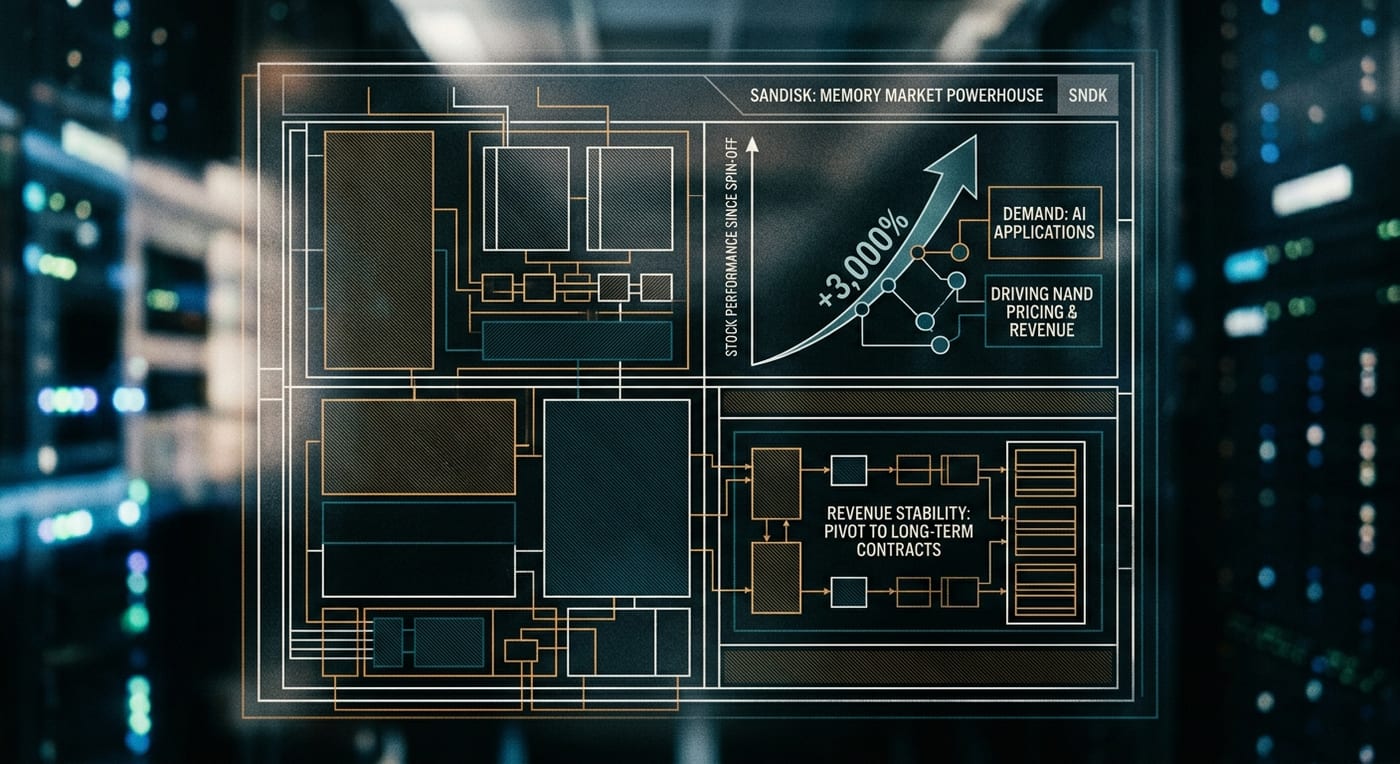
- Sandisk's stock has surged over 3,000% since its spin-off.
- Demand driven by AI applications boosts NAND pricing and revenue.
- Company pivots to long-term contracts for revenue stability.
Sandisk Corporation SNDK has emerged as a leading figure in the memory chip industry, characterized by its dramatic stock price growth and robust revenue performance driven primarily by increasing demand for NAND flash memory. This article explores Sandisk's transformation, the underlying market dynamics, and its strategic positioning amid fluctuating industry conditions.
Surging Demand and Market Valuation
In the past year, Sandisk's stock has experienced remarkable growth, soaring over 3,000% since it separated from Western Digital. The share price witnessed fluctuations, peaking above $2,350 before settling at approximately $1,786.85, reflecting a nearly 600% year-to-date increase despite a recent dip of about 30% from its peak. Investors are grappling with the sustainability of this impressive rally, leading to ongoing speculation about the company's future prospects as the memory chip market remains cyclical.
The demand for NAND memory is predominantly driven by the explosive growth of artificial intelligence (AI) applications, where high-performance data storage capabilities are paramount. Despite recent price corrections, industry analysts are optimistic about Sandisk's long-term potential. The company benefits significantly from the current memory chip shortage, allowing it to capitalize on elevated prices that have translated into robust revenue growth.
Strategies for Stability and Growth
Sandisk has been proactive in navigating the complexities of the semiconductor market. A key strategic shift has been the pivot towards long-term contracts with major customers, aimed at stabilizing revenue and fostering predictable growth amid tightening supply constraints. This approach has become increasingly essential as enterprises ramp up their AI infrastructure, driving intense demand for NAND flash components used in data centers.
According to recent insights, Sandisk's management anticipates its addressable market to triple this year, targeting a market size of $300 billion by leveraging its technology and scale. Furthermore, the NAND flash memory market is projected to grow to $500 billion by 2027, with Sandisk optimally positioned to secure a more significant revenue share from this expansion, particularly as it pertains to data center needs.
Managing Market Cycles and Investor Sentiment
While Sandisk's growth trajectory appears promising, the cyclical nature of the memory chip market introduces volatility that can impact investor sentiment. The market remains wary of Sandisk's elevated valuation relative to its performance, especially as prices of memory products may eventually stabilize following the resolution of supply chain constraints. Currently, Sandisk trades at a price-to-earnings (P/E) ratio of about 7.6, which is notably lower than many peers in the tech sector.
Market observers suggest that this low valuation may reflect skepticism about Sandisk's ability to maintain its growth rate amidst eventual price corrections in the memory chip landscape. Recent trends indicate that as supply increases, prices may observe downward pressure, and investors are cautious about how this shift will affect future profitability. However, if Sandisk maintains its position and continues to deliver strong growth metrics, analysts predict a potential increase in its stock valuation over time as market conditions evolve.
In a prior analysis, it was noted that despite recent fluctuations, Sandisk's valuation had significant upside potential. The memory chip shortage could continue for several years, positioning Sandisk as a compelling candidate for investors looking for value in the tech sector.
Future Outlook and Revenue Projections
Looking ahead, analysts anticipate that Sandisk's revenue growth will not only continue but could also accelerate as current trends in AI and data management burgeon. Projections indicate revenue could reach $58 billion by fiscal 2028, illustrating a healthy expansion trajectory. The company itself is targeting mid-to-high teen revenue growth through 2030, alongside maintaining robust gross margins around 80%. Such projections further reinforce analysts' expectations that Sandisk is effectively positioned to thrive even as the market stabilizes.
This potential for growth is underscored by Sandisk's ongoing efforts to innovate and enhance product offerings, ensuring that its technology remains at the forefront of industry demands. The focus on AI-driven applications and expanding partnerships within this sector are likely to yield significant benefits, further solidifying Sandisk's reputation as a market leader.
Conclusion
In summary, Sandisk Corporation stands as a formidable presence in the memory chip market, marked by phenomenal stock performance and strategic initiatives aimed at ensuring sustained growth. While the semiconductor market's cyclical nature brings uncertainty, Sandisk's proactive strategies, adaptability to market changes, and growing addressable market paint a promising picture for the company's future. Investors and industry watchers alike will be keenly observing how Sandisk navigates these challenges and capitalizes on emerging opportunities in the evolving tech landscape. The same pressure is reflected in recent reporting on the issue, which helps explain why the company's pricing decisions remain under scrutiny.