
SpaceX: Charting the Path Forward
ED
Editorial
Cashu Markets·5 min read
TL;DR
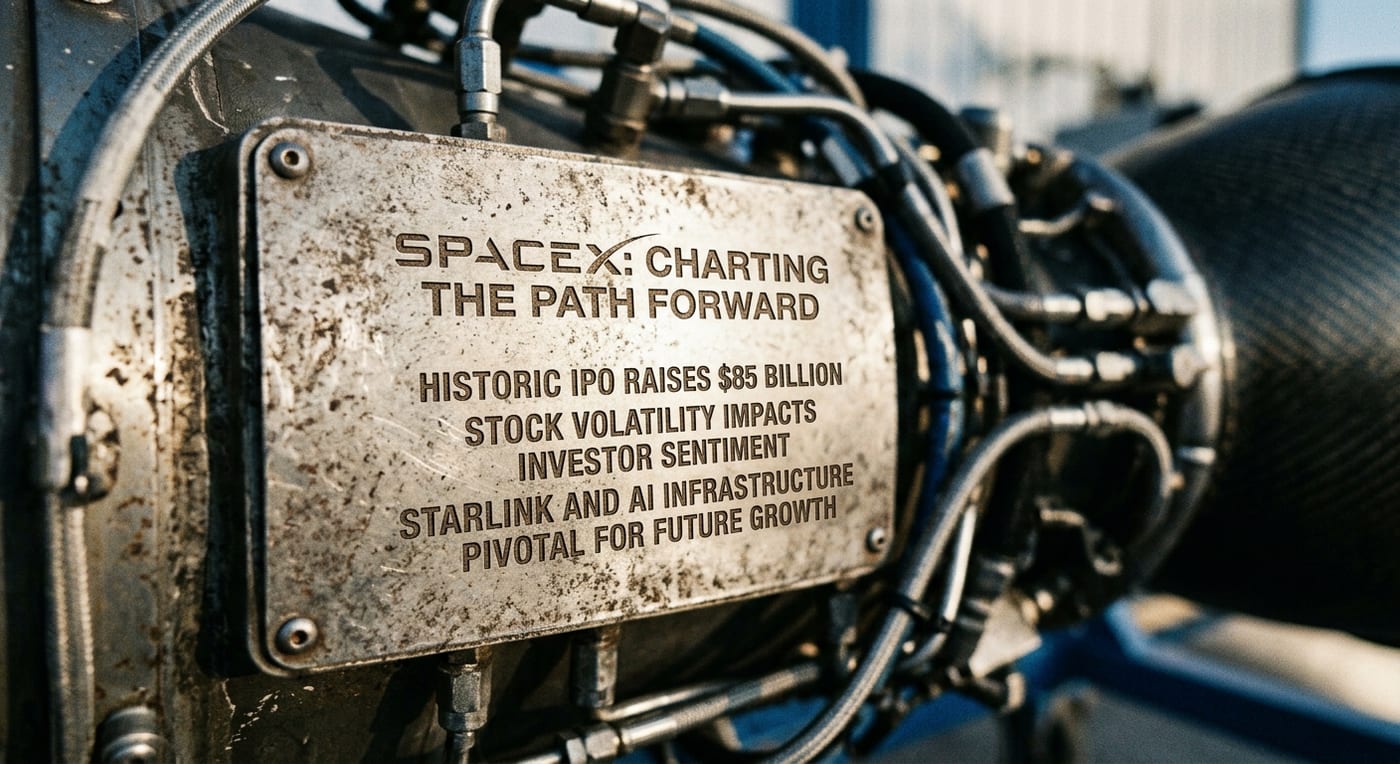
- SpaceX raised $85 billion in its historic IPO.
- The stock has experienced substantial volatility, impacting investor sentiment.
- Starlink and AI infrastructure are pivotal for the company's future growth.
Space Exploration Technologies Corp. (SPCX) is drawing attention as the latest developments come into focus. Space Exploration Technologies Corp. (SPCX) has quickly become a focal point in the aerospace and technology sectors following its historic initial public offering (IPO) on June 12, 2026. The company raised an unprecedented $85 billion, propelling its market valuation to roughly $1.8 trillion at the outset, cementing its position as one of the most valuable companies in the world. However, the journey since its IPO has been tumultuous, with the stock experiencing considerable volatility and raising critical questions about its long-term viability and growth potential.
The IPO marked a significant milestone for SpaceX, attracting massive attention not just for the sheer scale of capital raised but also for what it represents in terms of scalability and ambition. Yet, the enthusiasm has met headwinds, as the stock price has fallen from its initial high of $225.64 to hovering around $135, marking a stark contrast to the initial optimism surrounding the offering.
Understanding the Initial Excitement
The rampant excitement surrounding the IPO stemmed largely from SpaceX's visionary projects and the charismatic leadership of CEO Elon Musk. The company aims to revolutionize space travel and communication through initiatives such as Starlink, a satellite-based internet service, and a robust pipeline of artificial intelligence (AI) operations. While Musk's bold aims inspired investor interest, the empirical financial results tell a more cautionary tale.
As detailed in recent analyses, SpaceX reported a staggering loss of approximately $4.28 billion for the first quarter following the IPO, generating $4.7 billion in revenue during the same period. Investors have since moved to reassess the company's long-term profitability metrics amidst these challenges, impacting stock valuations significantly. The analysis highlights diverging opinions on its future, as bulls argue for the potential of its growing addressable market while bears caution against its unprofitable business model and high operating costs related to ongoing ambitious projects.
Starlink: The Growth Engine
One of the shining stars (no pun intended) within SpaceX's portfolio is undoubtedly Starlink. The satellite internet service provides connectivity to underserved regions, and with over 10 million users, it stands as a major revenue-generating component. Recent developments highlight SpaceX's ambitions to expand Starlink significantly. The company has filed a request with the Federal Communications Commission (FCC) to deploy up to 100,000 Gen3 satellites, a move projected to dramatically enhance internet speeds and capacity.
The proposed expansion underlines how critical Starlink will be in driving profitability and revenue growth. However, this venture is not without challenges. Current manufacturing capabilities notably lag behind the ambitious target of building 100,000 satellites, with the current rate of production at merely 70 satellites per week. Given this constraint, experts ponder if SpaceX has the requisite capabilities to fulfill these goals in a timely manner.
Moreover, as SpaceX is focusing on launching its new Gen3 satellites, the infrastructure overhaul necessitates enhancements to its next-generation Starship rockets, which remain under development. Consequently, the success of Starlink is intrinsically tied to upcoming developments on these fronts, intertwining its future with SpaceX's overall viability.
AI Infrastructure as a New Frontier
While Starlink serves as the backbone of SpaceX’s revenue, AI infrastructure is an emerging frontier that presents new opportunities. The company has secured lucrative contracts, notably with giants like Alphabet, which will pay SpaceX roughly $920 million per month for access to its advanced Nvidia GPU infrastructure. This partnership suggests a promising future for revenue generation linked to AI operations. As outlined in earlier financial assessments, such arrangements could bolster revenues significantly—predictions estimate these contracts could amount to approximately $26 billion annually if fully realized.
The performance of these projects may hinge on the company's ability to address both operational complexities and competition within the AI space. Without these contracts materializing fully, analyst sentiments tilt toward skepticism regarding SpaceX's ability to leverage its AI capacity effectively.
Navigating Competition and Market Factors
Indeed, competing satellite internet service providers are intensifying the competition for SpaceX. Other companies are actively working on similar technologies, challenging Starlink’s market share. Such competition may exert additional pressure on pricing strategies and could impact revenue forecasts adversely. Moreover, concerns regarding the company’s massive initial valuation have begun to surface, as market conditions shift and uncertainties loom over broader economic factors affecting investor sentiment.
Market analysts forecast that while the sky remains the limit in terms of potential growth, the rapid price volatility seen after the IPO may require a recalibration of investor expectations. Market analysts draw parallels to early valuations of other tech companies, suggesting that while SpaceX's long-term prospects remain bright, the path to profitability could be convoluted and prolonged.
Conclusion: A Long-Term Play
The story of Space Exploration Technologies Corp. (SPCX) encapsulates both the optimistic potential and the stark challenges of an ambitious undertaking. While many analysts believe that innovations in Starlink and AI could pave the way for significant breakthroughs and revenue streams, the realities of production bottlenecks, competition, and unprofitability paint a more cautious picture.
In light of this intricate landscape, investors are advised to adopt a long-term perspective. The market's enthusiasm may ebb and flow, but the core ambitions of SpaceX remain intact—propelling humanity into a new era of space exploration and connectivity. The key will be to monitor operational progress closely as the company navigates through not only market expectations but its prolific aspirations on Earth and beyond. The same pressure is reflected in recent reporting on the issue, which helps explain why the company's pricing decisions remain under scrutiny.