
Tesla's Bold Expansion into Robotics and Autonomy
ED
Editorial
Cashu Markets·5 min read
TL;DR
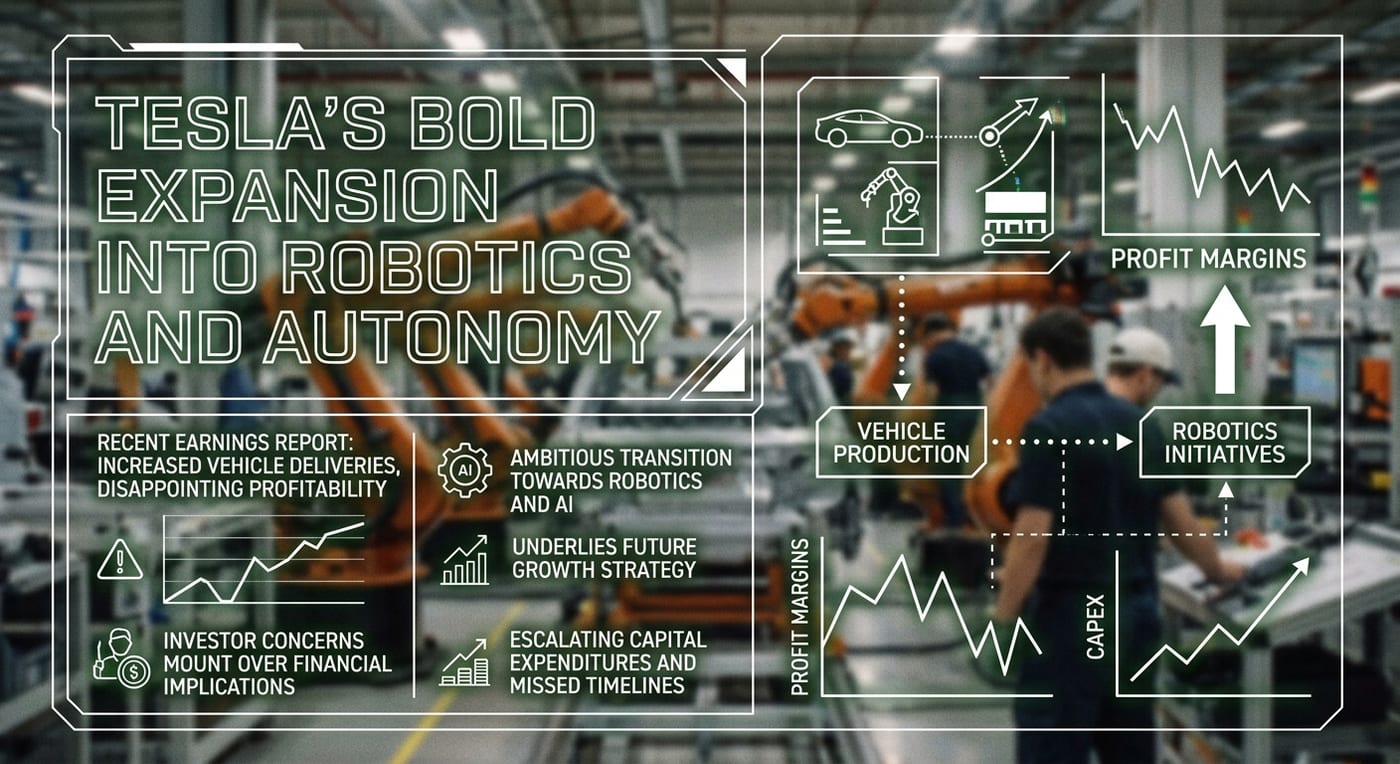
- Tesla's recent earnings report revealed a significant increase in vehicle deliveries but disappointing profitability.
- The company's ambitious transition towards robotics and AI underlies its future growth strategy.
- Investor concerns mount over the financial implications of escalating capital expenditures and missed timelines.
Tesla, Inc. (TSLA) has undergone a remarkable transformation as it broadens its horizons beyond traditional electric vehicles into the daunting arena of robotics and autonomous technology. This evolution, while ambitious, is met with both optimism and scrutiny as the market reacts to Tesla's new strategic direction amidst recent earnings challenges and cash flow concerns.
A Dramatic Earnings Report
In its recent earnings report, Tesla showcased a significant increase in vehicle deliveries, with 480,126 units shipped in the second quarter—marking a 25% rise compared to the previous year. However, the optimism faded as investors reacted to the company’s disappointing earnings performance, where adjusted earnings per share (EPS) fell short of expectations, dropping to 0.34 compared to a forecast of 0.50. Analysts were notably concerned about soaring operational costs, which led to the company reporting negative free cash flow for the first time in over two years, an indicator of the strain from increased spending on futuristic projects like the Optimus humanoid robot and advanced AI technologies.
This staggering increase in expenditures—up 142% year-on-year—was aimed at propelling Tesla’s ambitious robotaxi and humanoid programs. Yet, the negative free cash flow of $1.1 billion highlighted tensions between long-term growth aspirations and immediate financial health, prompting fears of unsustainable cash burns. Analysts at Argus Research expressed skepticism about Tesla's ability to achieve consistent profit growth, especially as operating margins compressed to 1.4% from 4.1% the prior year, showcasing the tug-of-war between growth initiatives and profitability.
The Shift Toward Robotics and AI
Elon Musk's vision goes beyond electric vehicles; it embraces a future intertwined with humanoid robotics through the Optimus project. Musk contends that Optimus could be “the biggest product ever,” intended to revolutionize manufacturing and daily tasks. However, progress remains tentative as the company continues to refine its production capabilities, with Musk admitting that the path to scalability faces significant hurdles, particularly in creating a reliable supply chain for components. The ambitious expectation for the humanoid robot to begin mass production soon is clouded by the daunting challenge of replicating human dexterity in a robotic form.
Reflecting on this huge strategic pivot, Tesla is not only attempting to introduce robots but is also under pressure to ensure that these developments yield tangible returns. The market's response has been mixed; whereas there are exciting prospects, the reality of “fantasy products”—as defined by experts—is still looming large. In essence, new developments must not only prove their viability but also must align with Tesla’s overarching financial targets to assuage growing investor concerns.
Robotaxi: Progress Amid Challenges
Tesla’s Robotaxi initiative has made strides, claiming nearly 2.5 million total paid miles and more than 380,000 unsupervised miles driven—without notable incidents. While Musk lauds these advancements as significant milestones, the project has evidenced slow expansion and unmet predictions regarding its rollout. Currently available in seven major U.S. cities, including Dallas and Houston, the robotaxi service is critiqued for being behind initial timelines Musk set, which promised deployment in a more expedited manner.
Furthermore, Tesla’s continuous adaptation in response to regulatory scrutiny further complicates rapid deployment efforts as it navigates the rigorous safety evaluations integral to the autonomous vehicle domain. Recent debates emphasize the need for balance between innovation and regulatory compliance.
Despite these tensions, the progress in unsupervised miles and robust safety records are promising aspects that continue to draw investor interest. The implications of a successful robotaxi service could fundamentally change urban mobility and Tesla’s revenue profile, which is currently heavily reliant on traditional vehicle sales.
Navigating Market Apprehensions
Tesla's stock bore the brunt of investor anxiety in the wake of its earnings report, with shares plummeting over 18% in a mere week, aligning with broader concerns over capital expenditure and missed profitability goals. This decline reflects a significant struggle for Tesla; its investor base must now reconcile ambitious promises against tangible results in a demanding market facing mounting competition and evolving consumer preferences.
In particular, the presence of newer, cost-effective entrants in the electric vehicle market steers consumer interest away from Tesla’s established models, straining demand for its offerings. As competitors unveil vehicles with compelling pricing and features, sustaining momentum in vehicle sales presents a legitimate challenge.
Moving Forward: Potential and Pitfalls
As Tesla continues to pursue its bold agenda in robotics and autonomous vehicles, the path will demand meticulous management of both technological innovation and fiscal responsibility. Shareholders remain cautiously optimistic, tracking the unfolding narrative as Tesla juggles the immense potential and inherent risks associated with such a transformative trajectory. The confluence of robotics and sustainability, if executed effectively, may provide Tesla with not merely an avenue for growth, but a means to redefine its entire business model.
While Tesla’s push into these promising sectors aligns with Musk's vision, investor patience will likely be tested as the road ahead is fraught with obstacles. Continued scrutiny is anticipated, particularly as expectations around profit generation and project timelines clash with the company’s broader ambitions. Therefore, striking the right balance between short-term financial health and long-term innovation could be critical for Tesla in navigating its multifaceted strategy successfully. The same pressure is reflected in recent reporting on the issue, which helps explain why the company's pricing decisions remain under scrutiny.