
TSMC Expands 3nm Chip Production Amid Strong Demand and Order Backlogs
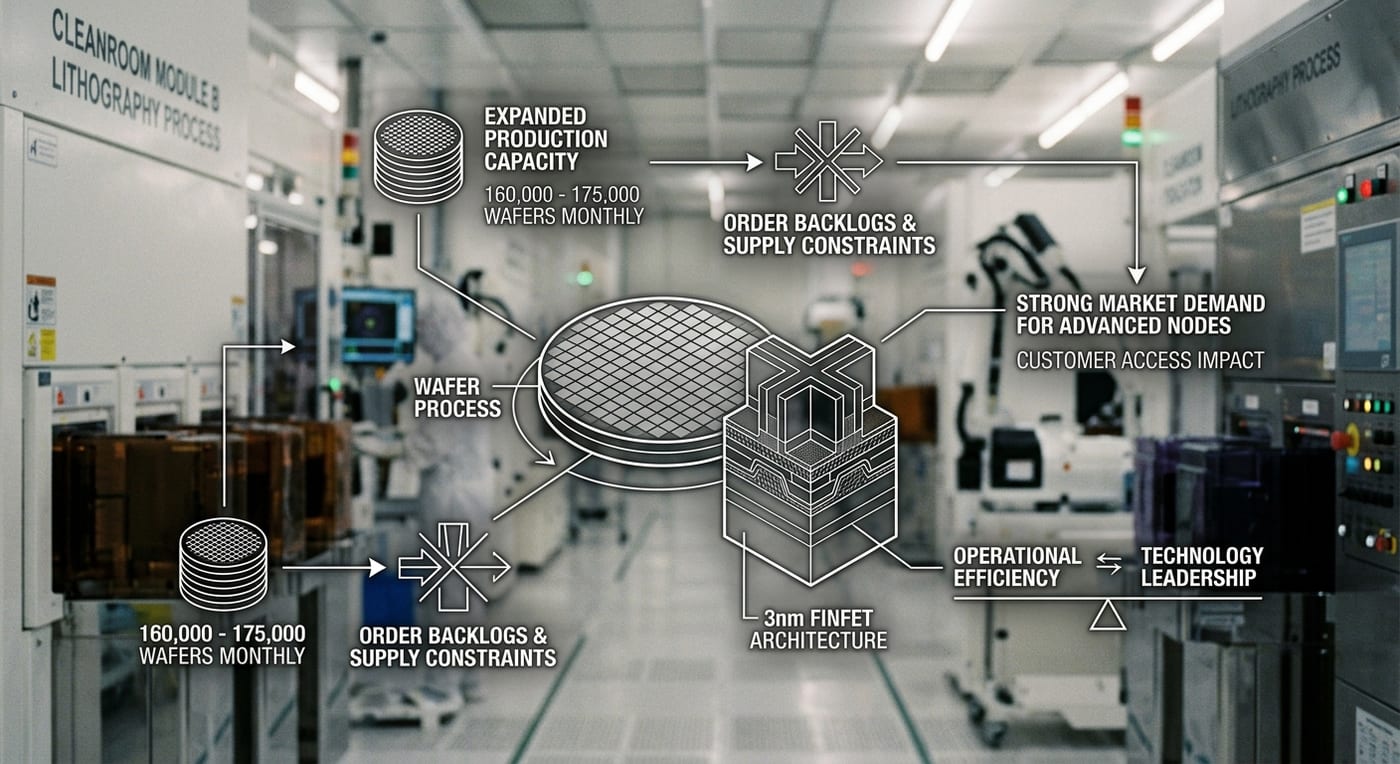
- TSMC has expanded 3nm chip production capacity to 160,000-175,000 wafers monthly to meet high demand.
- Despite increased production, TSMC faces substantial order backlogs, impacting customer access to advanced technologies.
- TSMC's advancements underscore its vital role in tech, balancing operational efficiency with high demand in the semiconductor market.
Taiwan Semiconductor Manufacturing Company (TSM) has taken significant steps to address the burgeoning demand for advanced semiconductor technology, particularly with its recent expansion of 3nm chip production. As of the second quarter, TSMC has ramped up its monthly production capacity for these cutting-edge chips to between 160,000 and 175,000 wafers. This increase is crucial in satisfying the high demand from various sectors, primarily high-performance computing and mobile applications. Despite this expansion, the continued strong demand has resulted in substantial order backlogs, indicating that even with increased production capabilities, TSMC may still struggle to meet customer needs fully. The implications of these backlogs could lead to challenges for clients seeking timely access to these advanced technologies.
In navigating this complex landscape, TSMC remains committed to its role as a leader in the semiconductor industry. The technological advancement associated with the 3nm process reflects not just a capability increase but also a strategic imperative in a globally competitive market where efficiency and performance are paramount. As TSMC continues to push the envelope in semiconductor capabilities, the evolving demand for innovative chips underscores its vital role in the tech ecosystem.
As TSMC continues to push the envelope in semiconductor capabilities, the evolving demand for innovative chips underscores its vital role in the tech ecosystem. TSMC's proactive measures to increase production capacity illustrate its dedication to meeting the challenges of a rapidly changing market while maintaining its status as a leading provider of semiconductor solutions.
Export Controls May Impact TSMC
In other noteworthy developments, Taiwan's government is weighing more stringent export controls on advanced AI chips, particularly those produced by TSMC. Such regulations, if implemented, could potentially restrict TSMC’s market access in China, a significant aspect of its customer base. This situation warrants close attention as it could have far-reaching implications for TSMC's operations amid a competitive global landscape.
Growth in AI Sector Fuels Semiconductor Demand
Furthermore, the excitement in the AI sector is palpable, with increasing demand for high-performance chips enhancing the role of companies like TSMC in the broader technology framework. The interdependence between innovation in AI applications and semiconductor capabilities signals long-term prospects for TSMC as the industry continues to evolve.
Related Cashu News

ASML's Growth Driven by AI Demand and Lithography Innovations Amid Semiconductor Trends
ASML Holding NV (Ticker: ASML) is at the forefront of a burgeoning semiconductor fabrication sector, driven by increasing demand for advanced memory solutions. The company is garnering attention from…

Lattice Semiconductor Navigates Financial Challenges Amidst AI-Driven Opportunities in FPGA Technology
Lattice Semiconductor (Ticker: LSCC) engages in an ongoing journey of technological innovation, particularly in the realm of low-power FPGA technology tailored for physical AI applications. The compan…

Investor Confidence in TSMC Rises Amid Growing Demand for AI Technology
Investors maintain a strong interest in Taiwan Semiconductor Manufacturing Company (TSMC) amid rising demand for artificial intelligence (AI) technology. The company's solid reputation as a leading se…

ST Microelectronics Partners with Oversonic Robotics to Advance Humanoid Robot Development
ST Microelectronics (Ticker: STM) collaborates with Oversonic Robotics to boost the development of cognitive humanoid robots. The partnership, announced recently, marks a significant step towards enha…