
USDTUSD Faces New Regulatory Challenges
ED
Editorial
Cashu Markets·5 min read
TL;DR
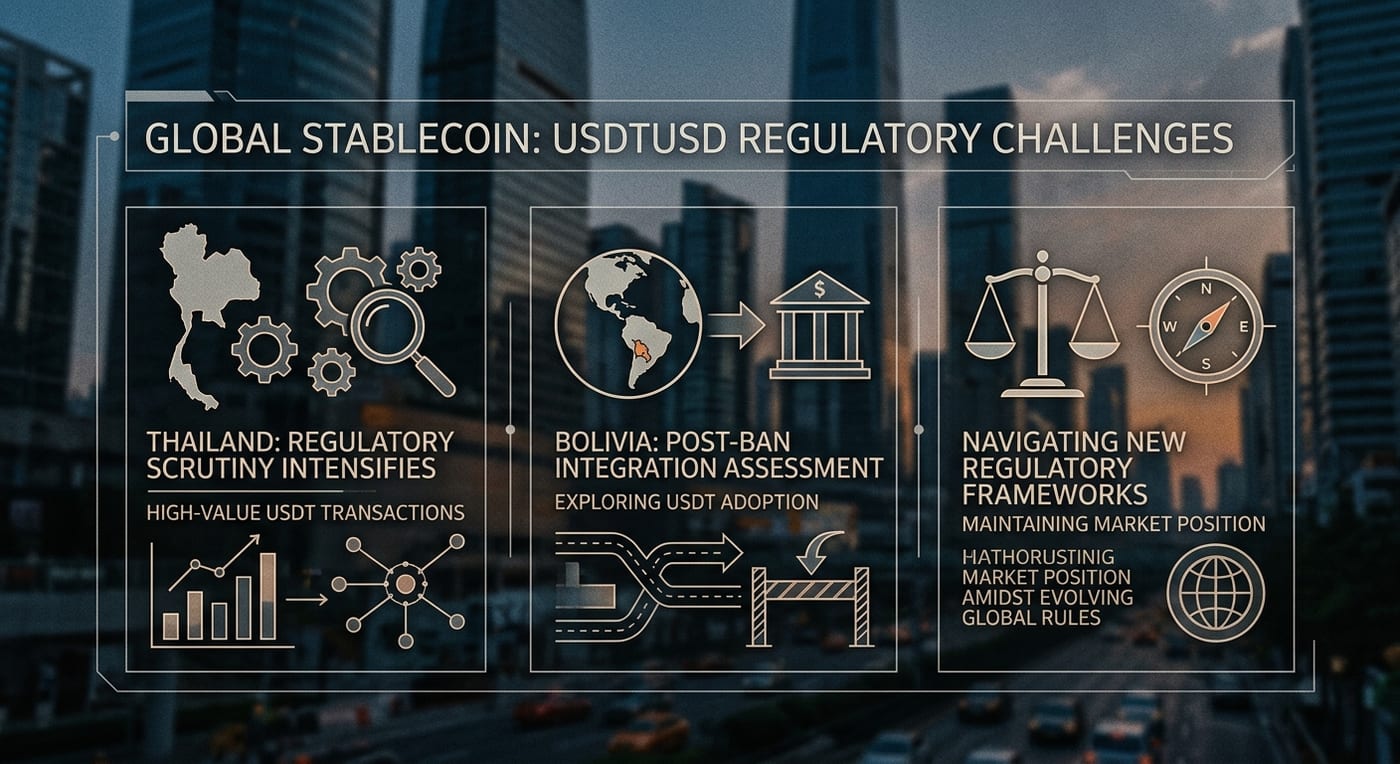
- Thailand intensifies scrutiny on high-value USDT transactions.- Bolivia assesses integrating USDT into its financial system post-ban.- Tether must navigate new regulatory challenges to maintain market position.
USDTUSD USDTUSD has emerged at the forefront of significant regulatory developments, particularly in markets like Thailand and Bolivia. As stablecoins like USDT navigate through evolving financial landscapes and regulatory scrutiny, it becomes essential to explore how these shifts impact its market positioning and future viability. In recent months, USDTUSD has found itself being closely monitored by financial regulators, most notably in Thailand where the Bank of Thailand (BOT) and the Securities and Exchange Commission (SEC) have ramped up scrutiny on high-value transactions. Consequent regulatory measures not only threaten the operations of USDT within the country but also aim to enforce stringent checks to combat illicit activities associated with large transactions. These developments come amid a growing global insistence on regulatory compliance for digital assets, where USDTUSD remains a central figure due to its dominance in the stablecoin market. As businesses globally seek reliable digital currencies to maintain transactional speed without compromising on regulatory compliance, USDTUSD’s ability to adapt will be critical in retaining its market position.
Heightened Scrutiny in Thailand
The current regulatory environment in Thailand underscores a rising focus on financial transparency, particularly concerning stablecoins like USDT. Recent measures initiated by the BOT involve requiring proof of the origin of funds exceeding 5 million baht (approximately $150,000). This move aims to tackle the shadow economy and prevent the use of digital assets for money laundering and financing illegal operations.
A comprehensive review of USDT transactions within Thailand entails examining not only their volume but also the ownership patterns behind these transactions. Indeed, the Bank of Thailand's decision seems geared towards ensuring that large transactions do not become a means to bypass domestic regulations or remittance protocols. The tightening of oversight forms part of a broader campaign as regulators align their measures with international anti-money laundering standards, which will have a direct effect on how USDT can be traded and utilized in the region. According to one report, 40% of USDT transactions were conducted by foreign nationals, which further complicates the compliance landscape and raises questions about regulatory loopholes that might need addressing soon.
The Thai authorities have issued a proactive approach, stating that these regulatory measures are not short-term fixes, indicating that USDT might need to navigate through a complex web of financial regulations moving forward. This dynamic situation presents numerous challenges and opportunities for USDTUSD as it seeks to maintain its standing as a reliable stablecoin.
Demand Expansion in Bolivia
Conversely, in a contrasting development, Bolivia is evaluating the potential integration of USDT into its national financial system following a reversal of its previous crypto ban. This move is a strategic response to the foreign exchange crisis that has seen trading volumes for USDT soar over 600% in early 2025. The Bolivian government, spearheaded by Economy Minister Jose Gabriel Espinoza, is currently in discussions on how to incorporate USDT alongside its fiat currency, the boliviano, and the United States dollar.
Bolivia's renewed stance on cryptocurrency adoption reflects the urgent need for alternative payment methods amid ongoing economic challenges. Last year, trading volumes experienced an explosive rise, illustrating the increasing demand for USDT as a dollar proxy in a market where local currency availability is diminishing. However, this proposed integration faces hurdles such as Bolivia's status on the Financial Action Task Force's gray list, leading to stringent anti-money laundering regulations.
As the government examines the feasibility of allowing USDT to circulate with existing currencies, it must establish a regulatory framework to ensure compliance with international standards to mitigate associated risks of financial crime. This intention to embrace cryptocurrencies, including USDT, positions it as a potential solution to the pressures of declining currency stability while also forging a path toward a more robust e-financing infrastructure.
Strategic Implications for USDTUSD
The intertwined scenarios emerging from both Thailand and Bolivia highlight the complex regulatory dynamics surrounding USDTUSD. In Thailand, the emphasis on regulatory compliance could see USDT facing operational hurdles that may affect its liquidity in the market. Conversely, Bolivia's potential acceptance indicates a possible expansion of stablecoins in markets with constrained financial systems.
The ongoing adjustments in the regulatory landscape will necessitate that Tether, the issuer of USDT, navigates these developments effectively. The ability to forge strategic partnerships, enhance compliance measures, and engage with regulators might provide Tether with the tools needed to sustain its market dominance. Building compliant pathways for USDT transactions could enable continued growth in markets that embrace cryptocurrency while adhering to stringent regulatory expectations.
Conclusion
USDTUSD's current position illustrates the dual ramifications of regulatory scrutiny and demand expansion across different regions. As regulatory bodies in various countries implement tighter controls, Tether must adapt, ensuring it meets compliance benchmarks while retaining user trust. It is within this complex landscape of financial regulations, scrutinized transactions, and potential market expansions that USDTUSD must carve a path forward, capitalizing on emerging opportunities without compromising on security and transparency. As the evolution of USAID and USDTUSD continues, both investors and users will closely monitor how these developments shape the cryptocurrency market, especially amidst ongoing discussions on regulatory compliance and financial stability across global markets. The same pressure is reflected in recent reporting on the issue, which helps explain why the company's pricing decisions remain under scrutiny.